Techniques that raise test performance after a test: a meta-analysis
Abstract
Section titled “Abstract”Background. Students in Avanti’s Centres of Excellence spend 3 to 4 hours a day studying on their own after class. This review asks which techniques, used after a test on the questions a student got wrong, raise scores on later JEE-style questions, and which of them an AI coach could deliver.
Methods. Four parallel reviews, searched on 1 November 2026, covered practice testing, spacing, mixed practice, feedback, worked and faded examples, expertise reversal, self-explanation, erroneous examples, problem-first instruction, contrasting cases, misconception refutation, the attempt rule under negative marking, and tutoring by people, software and AI. We extracted 181 effect sizes from about 115 meta-analyses and controlled studies, each checked in an archived copy of the source. For each technique we report one anchor meta-analysis, with the classroom trials outside it beside it. Only the AI-tutor trials were pooled, by random effects. Each technique gets a planning range on a delayed test of the coached material and, where the evidence allows, on a full exam, rated for certainty in the spirit of GRADE.
Results. Three findings have high certainty: teaching the ideas before practice (discovery without an explanation does worse, d = −0.38), practice testing for formulas and facts (g = 0.53 in classrooms), and human tutoring at scale (0.16 to 0.21 SD on standardised tests). Worked examples help students weak in a chapter (g = 0.48) and hurt strong ones (d = −0.43). Feedback that gives the correct answer is worth 0.32 SD, against 0.05 for right or wrong alone. Practice testing on multi-step problems, which is most of JEE, shows no reliable gain (g = −0.12 on procedures, 0.02 on transfer). Seven school trials of structured AI tutors pool to 0.16 SD (95% CI 0.05 to 0.28; prediction interval −0.21 to 0.54), and to 0.11 on independent tests.
Conclusions. On the coached chapters, a loop of the correct answer and the working, the student’s own error, worked examples for students weak in the chapter and an unaided retry plausibly moves scores by 0.3 to 0.6 SD. On JEE Main, where those chapters are a small share of the paper, we expect about 0.05 to 0.15 SD, with a real chance of zero. No study here was run with Indian students preparing for JEE or NEET.
1. Introduction
Section titled “1. Introduction”Avanti’s Centres of Excellence are residential, two-year programmes in which Avanti’s teachers deliver about 6 hours of teaching in Physics, Chemistry and Maths each day. Students there score about 16 to 21 JEE Main percentile points higher than students with the same Class-10 marks who received after-school instruction (Avanti Fellows 2026). Outside class they study 3 to 4 hours a day on their own, with Avanti’s modules, NCERT books and reference books.
Avanti’s earlier work putting digital content into the classroom had small or negative effects. Classroom videos with workbooks in Haryana lowered maths scores by about 0.15 SD (de Barros 2022), and the blended programme in Chennai did not move Class X board scores (Chiplunkar, Dhar and Nagesh 2020). This review therefore looks at the time after a test, on the questions a student got wrong, and asks what a coach, a teacher or an AI, should do with it. A JEE-style test is a timed paper of multiple-choice and numerical questions, marked +4 for a right answer and −1 for a wrong one.
The companion note, What works, summarises the findings for the programme. This paper sets out the evidence in full: the methods, the estimate behind each technique, the studies, and the limits. The strand-by-strand literature reviews and the reading library of papers read but not cited hold the wider reading behind it.
1.1 Question and scope
Section titled “1.1 Question and scope”Question. Which techniques, delivered after a test on the questions a student got wrong, raise performance on later JEE-style questions, and by how much?
Techniques covered. Practice testing, spacing, mixed (interleaved) practice, feedback, worked and faded examples, expertise reversal, self-explanation, erroneous examples, problem-first instruction, contrasting cases, misconception refutation, teaching the attempt rule under negative marking, and tutoring by people, software and AI.
Population of interest. Students in Grades 11 and 12 preparing for competitive STEM entrance exams, many from low-income families, in India.
Outcomes. Two, kept apart throughout:
- A delayed test of what was coached. New questions on the same idea, days to weeks later, without help. This is what the coach can move directly.
- A full exam. A full-length mock or JEE Main itself. Every technique shrinks here, because the coached ideas are a small part of the paper and the exam is written by someone else.
2. Methods
Section titled “2. Methods”Search. Four reviews ran in parallel, one per group of techniques, each with the same instructions:
- Check every figure against its primary source.
- Find the best meta-analyses and the strongest classroom trials, prioritising secondary-school STEM, real classrooms over the lab, high-stakes exams, and low- and middle-income countries.
- Include work from 2020 to 2026.
The searches ran on 1 November 2026. They missed one report released three days earlier, the second UK trial of Gemini tutoring on the Eedi platform (LearnLM Team, Google and Eedi 2026): the reviews searched by topic, and none went back to the research groups whose earlier trials they already held. It was added on 2 November and is in the pools below.
Inclusion. Meta-analyses and randomised or quasi-experimental studies with a comparison group. Narrative reviews were used for context only. A number is cited only if it was read in an archived copy of the source. Sources read as abstracts only are marked; their pooled figures are not treated as verified. Sources behind publisher bot checks were not opened and are not used.
Extraction. For each estimate the review records (Appendix A):
- design, population and country
- comparison, outcome and delay
- effect size and its 95% CI or standard error
- number of studies and participants
- heterogeneity, any bias-adjusted estimate and moderators
- whether it is independent of the other rows, meaning not already inside a pooled meta-analysis in the table
Effect metric. Standardised mean differences (Hedges’ g or Cohen’s d), in SD units. Where a paper reported a coefficient, it was divided by the control-group SD; the conversion is noted in the table.
Synthesis. Most techniques already have a good meta-analysis, and most classroom trials sit inside one. Pooling a meta-analysis with the studies it already contains would count them twice, so three rules apply:
- For each technique, one anchor. The most relevant meta-analysis, preferring classroom samples and secondary school, is reported as published, with any bias-adjusted estimate beside it.
- Classroom trials outside the anchor are reported next to it, not pooled into it. When they disagree with it, they move the planning range.
- Formal pooling only where independent trials answer one question. Only the AI-tutor trials met that bar. They are pooled by random effects (DerSimonian-Laird), with a Hartung-Knapp-Sidik-Jonkman interval and a 95% prediction interval (Appendix A).
Planning range. For each technique the review gives a range for a delayed test of what was coached and, where it can, one for a full exam such as JEE Main. These are judgements drawn from the evidence, not confidence intervals. Each one says what it rests on.
Certainty. Each range is rated High, Moderate, Low or Very low, in the spirit of GRADE. A rating starts at High for a classroom meta-analysis and drops a level for each of:
- mostly lab or university samples
- signs of publication bias, or no bias check at all
- high heterogeneity, or a prediction interval that crosses zero
- outcomes written by the researchers rather than independent tests
- a single small study
3. Results
Section titled “3. Results”The techniques in plain terms, by strength of evidence
Section titled “The techniques in plain terms, by strength of evidence”1. A strong case to try today. Consistent evidence, little cost, nothing to build.
| Technique | What it means | On a JEE topic | Why it is here |
|---|---|---|---|
| A clear lesson first | The ideas are taught directly before any practice | A lesson on Gauss’s law before the problem set | Leaving students to discover the ideas does worse, with high certainty |
| Worked examples, for weak students | A fully solved problem the student studies step by step before solving one | A solved projectile problem, every step shown and labelled | 55 studies in maths, and the same learning in about half the time |
| Straight to problems, for strong students | Skip the worked examples once a student knows the chapter | A student scoring well on kinematics goes straight to the problem set | Worked examples make strong students learn less |
| Feedback that gives the correct answer | After a wrong answer, show the right one and the working, not just a cross | “Wrong, it is (C)”, with the solution | Most of the value of feedback; a cross alone does almost nothing |
| Practice testing, for formulas and facts | Answering questions from memory instead of rereading notes | A closed-book quiz on the rotational motion formulas | The best-evidenced technique there is, for things that can be recalled |
| Spacing | Spreading practice on a topic over days and weeks instead of one block | Three short sets on electrostatics across three weeks, not one long evening | Reliable in real classrooms, if smaller than in the lab |
| Human tutoring at scale | Regular one-to-one or small-group tutoring by trained tutors inside a school programme | Three 30-minute sessions a week in groups of two or three | High certainty on standardised tests; the cost is people, not evidence |
2. Experiments worth trying. Promising, but either the evidence is thin, it comes from a different setting, or it has not shown up on real exams. Try with a comparison group.
| Technique | What it means | On a JEE topic | Why it is here |
|---|---|---|---|
| Retry a new question, unaided | After seeing the solution, try a fresh question of the same kind with no help | A second projectile question, set the next day | Carries about half the classic tutoring effect, but never tested on its own |
| Explanation on top of the correct answer | Say why the right answer is right and why the chosen one is tempting | “Wrong, it is (C), because the field inside a conductor is zero” | Adds a little over the correct answer; in maths transfer questions the plain answer did better |
| Refuting the misconception | Naming the wrong idea, showing where it fails, then giving the right one | “Many think a heavier object falls faster. Here is why it does not.” | Works in reading studies with university students; only 4 studies in secondary school |
| Faded worked examples | The same solved problem with steps removed one at a time for the student to fill in | The projectile problem with the last step blank, then the last two | Small trials only, all pointing the same way |
| Self-explanation prompts | A short question at a key step asking the student why it holds | “Which law gives this equation?” with three options to choose from | Helps, mostly for concepts, and takes time away from practice |
| Mixed (interleaved) practice | A set that mixes question types, so the student has to choose the method | Kinematics, work-energy and momentum questions shuffled together | Helps on topic tests, not yet on real exams |
| Problem first, for concepts | The student attempts a new kind of problem before being taught it | Try to predict what a second lens does, then the lesson | Helps understanding of ideas, not procedures |
| Structured AI tutor | An AI that follows a set lesson and holds back the answer, unlike a general chatbot | Walks a student through one wrong answer, step by step | Six school trials average about 0.2 SD, with a wide spread |
| Step-based tutoring software | Software that checks each line of the working, not only the final answer | Flags the line where a sign was dropped | Real but small gains on standardised tests at scale |
| Adaptive practice software | Software that picks the next question from the student’s answers so far | Two misses on limits, so the next question is an easier limit | Helps below-grade skills in India; no gain on grade-level exams |
3. Weak evidence. Little or no support for JEE-type problems.
| Technique | What it means | On a JEE topic | Why it is here |
|---|---|---|---|
| Practice testing, for multi-step problems | Quizzing yourself on a procedure you cannot yet do | A closed-book attempt at a full mechanics problem before seeing one solved | Nothing measurable in real classrooms |
| Problem first, for procedures | Attempting a new kind of calculation before being taught it | Try a titration calculation, then the lesson | No gain on procedures |
| Erroneous examples | A solution with a planted mistake for the student to find and fix | A solved titration with the mole ratio inverted | Small effect, and only when the error is then explained |
| Contrasting cases | Two problems side by side that differ only in the feature that matters | The same block on a smooth and on a rough incline | Promising, but 4 studies with teenagers |
Two practices have strong evidence against them: leaving students to discover ideas with no explanation afterwards, and giving worked examples to students who already know the chapter.
Reading the numbers. g and d are effect sizes in standard deviations (SD). An effect of 0.1 SD moves a student at the middle of the class from the 50th to about the 54th percentile; 0.2 SD to about the 58th; 0.4 SD to about the 66th.
Planning ranges
Section titled “Planning ranges”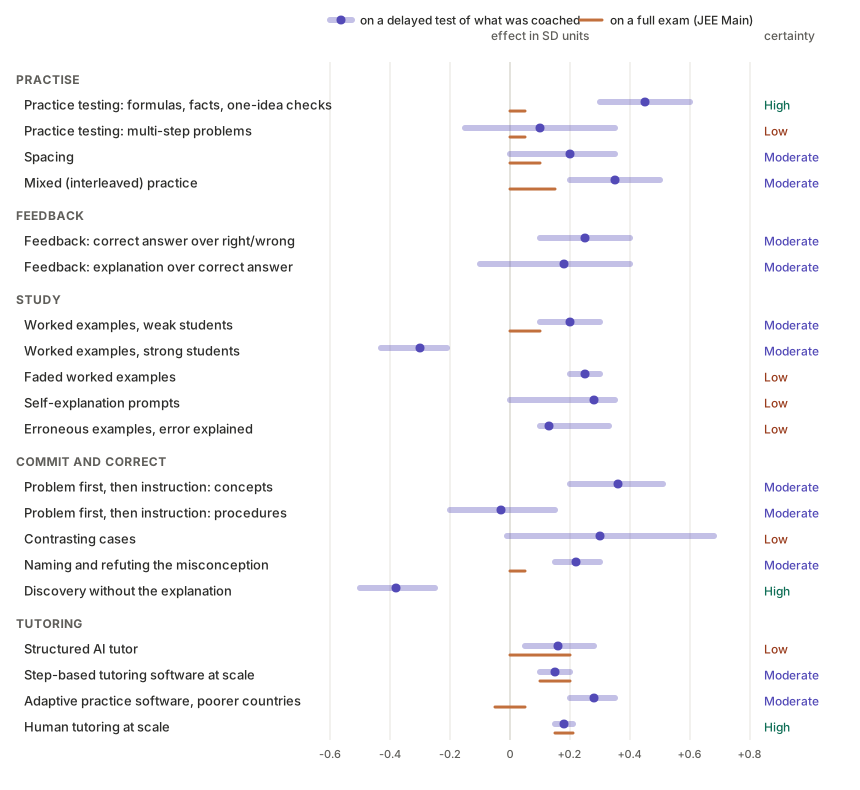
Thick bar and dot: planning range and central estimate on a delayed test of what was coached. Thin bar: on a full exam such as JEE Main. Ranges are judgements from the evidence, not confidence intervals.
Two kinds of test. Each technique gets two ranges because it is measured on two different tests.
- Coached material. A test, days or weeks later, on the ideas the technique was used on: new vector-algebra questions after a vector-algebra lesson. Almost every study measures this.
- Full exam. A whole paper the coach did not write, such as JEE Main or a full-length mock. The coached ideas are a small share of its marks, so the same gain is diluted across the rest of the paper. Few studies measure this, so these ranges are our extrapolation, and the column is blank where the evidence gives no basis for one.
The gap between the two columns is the main reason to expect small effects on JEE.
| Technique | Anchor estimate | Planning range, coached material | Planning range, full exam | Certainty |
|---|---|---|---|---|
| Practice testing: formulas, facts, one-idea checks | g = 0.53 classroom (Ruitenburg et al. 2026); 0.50, bias-adjusted 0.43 to 0.48 (Yang et al. 2021) | 0.30 to 0.60 | 0.00 to 0.05 | High |
| Practice testing: multi-step problems | g = −0.12 procedural, 0.02 transfer (Ruitenburg et al. 2026) | −0.15 to 0.35 | 0.00 to 0.05 | Low |
| Spacing | g = 0.20 [0.03, 0.36] (Ruitenburg et al. 2026) | 0.00 to 0.35 | 0.00 to 0.10 | Moderate |
| Mixed (interleaved) practice | g = 0.40 classroom (Ruitenburg et al. 2026); maths 0.34 (Brunmair and Richter 2019) | 0.20 to 0.50 | 0.00 to 0.15 | Moderate |
| Feedback: correct answer over right/wrong | 0.32 vs 0.05 (Van der Kleij et al. 2015) | 0.10 to 0.40 | Moderate | |
| Feedback: explanation over correct answer | 0.71 vs 0.49 near items (Mertens, Finn and Lindner 2022) | −0.10 to 0.40 | Moderate | |
| Worked examples, weak students | g = 0.48 [0.36, 0.60], 0.44 trim-and-fill (Barbieri et al. 2023) | 0.10 to 0.30 | 0.00 to 0.10 | Moderate |
| Worked examples, strong students | d = −0.43 [−0.65, −0.21] (Tetzlaff et al. 2025) | −0.43 to −0.21 | Moderate | |
| Faded worked examples | no pooled estimate; g = 0.64 and 0.29 (Renkl et al. 2000) | 0.20 to 0.30 | Low | |
| Self-explanation prompts | g = 0.55, high school 0.43 (Bisra et al. 2018) | 0.00 to 0.35 | Low | |
| Erroneous examples, error explained | g = 0.14 (Alemdag et al. 2025, abstract) | 0.10 to 0.33 | Low | |
| Problem first, then instruction: concepts | g = 0.36 [0.20, 0.51] (Sinha and Kapur 2021) | 0.20 to 0.51 | Moderate | |
| Problem first, then instruction: procedures | g = −0.03 [−0.20, 0.15] (Sinha and Kapur 2021) | −0.20 to 0.15 | Moderate | |
| Contrasting cases | d = 0.34 [−0.01, 0.68] adolescents (Alfieri, Nokes and Schunn 2011) | −0.01 to 0.68 | Low | |
| Naming and refuting the misconception | g = 0.41 [0.30, 0.51], 0.28 trim-and-fill (Schroeder and Kucera 2022) | 0.15 to 0.30 | 0.00 to 0.05 | Moderate |
| Discovery without the explanation | d = −0.38 [−0.50, −0.25] (Alfieri et al. 2011) | −0.50 to −0.25 | High | |
| Structured AI tutor | 0.16 [0.05, 0.28], seven trials (this review) | 0.05 to 0.28 | 0.00 to 0.20 | Low |
| Step-based tutoring software at scale | 0.08 to 0.20 on standardised tests (Kulik and Fletcher 2012; Leite et al. 2025) | 0.10 to 0.20 | 0.10 to 0.20 | Moderate |
| Adaptive practice software, poorer countries | 0.18, adaptive 0.35 (Major, Francis and Tsapali 2021) | 0.20 to 0.35 | −0.05 to 0.05 | Moderate |
| Human tutoring at scale | 0.16 to 0.21 on standardised tests (Kraft, Schueler and Falken 2024) | 0.15 to 0.21 | 0.15 to 0.21 | High |
3.1 Learn the basics in a lesson first
Section titled “3.1 Learn the basics in a lesson first”Evidence: high. Discovery without the explanation does worse across a large meta-analysis.
Struggle first helps with ideas, not procedures. Solving a problem before instruction beats instruction first on concepts and transfer (g = 0.36 [0.20, 0.51]) but not on procedures (−0.03 [−0.20, 0.15]) (Sinha and Kapur 2021). Their “bias-corrected 0.87” is a p-curve estimate that moves upward and should not be quoted. Discovery without the explanation loses to explicit teaching (d = −0.38, adolescents −0.53), and guided discovery in science gives only 0.11 (Alfieri et al. 2011).
The studies.
| Study | What it was | Who and where | Students |
|---|---|---|---|
| Alfieri et al. 2011 | Meta-analysis: discovery learning against explicit teaching, and discovery with guidance | Children, adolescents and adults; maths, science and other subjects | 5,226 learners in 108 studies (unguided); 4,243 in 56 studies (guided) |
| Sinha and Kapur 2021 | Meta-analysis: solving a problem before being taught (productive failure) against teaching first | Grade 2 to adults, most comparisons in Grades 6 to 10; mostly maths and science; Asia, North America, Europe | 53 studies, 166 comparisons (students not reported) |
3.2 Weak in the chapter: solved examples before practice
Section titled “3.2 Weak in the chapter: solved examples before practice”Evidence: moderate. Strong in maths meta-analyses, smaller in real classrooms, where the dependable benefit is time saved.
Worked examples are the best-evidenced technique for weak students, mostly through time saved. Against problem solving in maths, g = 0.48 [0.36, 0.60] across 55 studies, 0.44 after trim-and-fill (Barbieri et al. 2023). Heterogeneity is extreme (I² = 94%), and a new study could land anywhere from about −1 to +2. Classroom trials are smaller:
- Booth et al. 2015, 425 Algebra I students randomised within classrooms: assignments that swapped some practice problems for correct and incorrect worked examples with explanation prompts raised end-of-unit scores by 0.10 SD (intent to treat), a gain too small to rule out zero (95% CI −0.06 to 0.26). Students who started with less prior knowledge gained more.
- McLaren et al. 2016, two Grade 10 to 11 chemistry trials: worked examples, erroneous examples, tutored problems and plain problem solving all produced the same learning, and worked examples took 46 to 69% less time.
For a student short of hours before JEE, the time saving is the dependable benefit.
Practice testing works for what can be recalled, not for long procedures. The classic result holds: a week after study, tested students recalled 56% of a passage against 42% for rereaders, though rereaders were ahead at five minutes (Roediger and Karpicke 2006). The meta-analyses agree on direction: g = 0.50 in a lab pool (Rowland 2014), 0.50 across 574 classroom effects with a bias-adjusted 0.43 to 0.48 (Yang et al. 2021), and against restudy alone 0.33.
The closest match to our students is a 2026 meta-analysis of real primary and secondary classrooms: 53 studies, 7,303 students (Ruitenburg et al. 2026). Retrieval practice gave g = 0.37 overall and 0.52 in secondary school, but −0.12 [−0.61, 0.38] on procedural knowledge and 0.02 on transfer. Testing in maths alone gave g = 0.18, with a CI crossing zero (Murray, Horner and Goebel 2025). Eight experiments on learning multi-step problems from worked examples found no testing benefit (summarised in van Gog and Sweller 2015); a reply argues for a small positive effect (Karpicke and Aue 2015, abstract only). For a procedure the student cannot yet do, studying a solution beats trying to recall one.
The studies.
| Study | What it was | Who and where | Students |
|---|---|---|---|
| Barbieri et al. 2023 | Meta-analysis of worked examples against problem solving in maths (53 randomised trials, 2 quasi-experiments) | Primary to college, mostly middle school and up; 23 US and 20 non-US articles | 55 studies, 181 effects (students not reported) |
| Booth et al. 2015 | Classroom trials of the Algebra by Example worked-example assignments, one unit | Non-honours Algebra I, high school, five US districts | 425 (main trial); 51 in a three-class trial |
| McLaren et al. 2016 | Two classroom trials of six 40-minute sessions: worked examples, problem solving, erroneous examples and tutored problems | Grades 10 to 11 chemistry (stoichiometry), US | About 155 and 116 |
| Roediger and Karpicke 2006 | Lab experiment: testing against restudying a passage, recall after 5 minutes, 2 days and a week | US undergraduates | 120 |
| Rowland 2014 | Meta-analysis of the testing effect | Mostly lab studies with undergraduates; word lists and prose; mostly US | 61 studies, 159 effects |
| Yang et al. 2021 | Meta-analysis of quizzing in real classrooms | Primary school to university | 48,582 in 223 studies |
| Ruitenburg et al. 2026 | Meta-analysis of retrieval practice and spacing in real school classrooms | Primary and secondary; US, Netherlands, Germany, Brazil and others | 3,391 in 31 studies (retrieval) |
| Murray, Horner and Goebel 2025 | Meta-analysis of testing and spacing in maths | Lab and course studies | 7 studies (testing), 27 studies (spacing) |
| van Gog and Sweller 2015 | Review of experiments on whether testing helps with complex material | University, vocational and primary students; Netherlands and Australia | 8 experiments |
| Karpicke and Aue 2015 | Reply to van Gog and Sweller (abstract read) |
3.3 Then complete solutions with steps missing
Section titled “3.3 Then complete solutions with steps missing”Evidence: low. Small trials only, all pointing the same way.
Fading has no pooled estimate. The most-cited classroom result, near transfer 79% against 62% (Renkl, Atkinson and Maier 2000), compares two intact classes of 20 and 15 after one lesson (g ≈ 0.64, CI −0.05 to 1.32). A second experiment with undergraduates gave g ≈ 0.29. Fading adapted to each student beat fixed fading on delayed retention in Cognitive Tutor studies (Salden et al. 2010).
The studies.
| Study | What it was | Who and where | Students |
|---|---|---|---|
| Renkl, Atkinson and Maier 2000 | Faded worked examples: a two-class quasi-experiment and a lab experiment | Grade 9, lowest-track school, Germany (physics); US psychology undergraduates (probability) | 35 (two classes); 54 |
| Salden et al. 2010 | Review of classroom studies adding worked examples to Cognitive Tutor software | High school geometry, algebra and chemistry; US and Germany | 4 geometry studies |
3.4 Then practise: spaced out and mixed
Section titled “3.4 Then practise: spaced out and mixed”Evidence: moderate. Reliable in classrooms, but smaller on real exams than on topic tests.
Spacing is reliable but smaller in classrooms. In the lab the best gap between study and review is about 20% of the time to the test for horizons of a few weeks, falling to about 5% at a year (Cepeda et al. 2008). In K-12 classrooms spacing gives g = 0.20 [0.03, 0.36], or 0.39 against fully massed practice and about zero against slightly less spaced practice (Ruitenburg et al. 2026). In nine real STEM courses the pooled gain was 2 percentage points, and the physics course went the wrong way (g = −0.12). In eight of those nine courses students saw only right or wrong, never the correct answer (Bego et al. 2024). An expanding schedule is no better than an even one (g = 0.03; Latimier, Peyre and Ramus 2021).
Mixed practice helps on targeted tests, less on real exams. Interleaving gives g = 0.40 in K-12 classrooms and 0.54 in maths (Ruitenburg et al. 2026); 0.34 in maths with a trim-and-fill overall estimate of 0.29 (Brunmair and Richter 2019). In a US Grade 7 trial, interleaved students scored 61% against 38% a month later (d = 0.83; Rohrer et al. 2020). Two findings hold it back for JEE:
- In undergraduate physics, big gains on surprise tests did not reach the real midterms (d = 0.20 and 0.02; Samani and Pan 2021).
- In a year-long Lagos trial, the term-test gain of 0.29 SD was not detected on the year-end test (0.04, CI about −0.27 to 0.35), with some sign of losses at the top (van der Haar et al. 2023).
With feedback after every item, interleaving showed no benefit (g = 0.03, 4 studies), against 0.82 with feedback at the end of the set (Ruitenburg et al. 2026). That rests on seven studies, so treat it as a hypothesis to test.
The studies.
| Study | What it was | Who and where | Students |
|---|---|---|---|
| Cepeda et al. 2008 | Online experiment varying the gap between study sessions and the final test | Adults learning obscure facts | 1,354 |
| Ruitenburg et al. 2026 | See 3.2: spacing in real school classrooms | ||
| Bego et al. 2024 | Questions randomly assigned to spaced retrieval within each student, nine courses | Introductory STEM undergraduates, University of Louisville | 578 in eight courses; 180 in calculus |
| Latimier, Peyre and Ramus 2021 | Meta-analysis of spaced against massed retrieval | Mostly undergraduates; 9 of 11 studies in the lab | 11 studies, 39 effects |
| Brunmair and Richter 2019 | Meta-analysis of mixed (interleaved) against blocked practice | Mostly adults in the lab; paintings, photos, maths, texts | 59 papers, 238 effects |
| Rohrer et al. 2020 | Class-randomised trial of mixed maths homework | Grade 7, Florida, 54 classes, 15 teachers | 787 |
| Samani and Pan 2021 | Two lecture sections swapped mixed and blocked homework | Introductory physics undergraduates, US | About 290 |
| van der Haar et al. 2023 | Class-randomised trial of mixed maths practice over a full year | Grade 5, low-cost private schools in Lagos, Nigeria, 58 schools | 665 (term tests); 518 (end of year) |
3.5 When wrong: the correct answer and the working, then the student’s own error
Section titled “3.5 When wrong: the correct answer and the working, then the student’s own error”Evidence: moderate. Two meta-analyses of feedback types agree; self-explanation is well supported; explaining one’s own error is untested.
The often-quoted comparison, d = 0.99 for explanatory feedback against 0.46 for right-or-wrong (Wisniewski, Zierer and Hattie 2020), does not compare like with like. The 0.99 rests on 42 effect sizes, its category adds self-regulation advice rather than “why”, and its 0.46 category already includes the correct answer.
Two better sources compare feedback types directly:
-
Mertens, Finn and Lindner (2022), randomised experiments only, each type against no feedback:
Feedback Near items Transfer items Right/wrong 0.24 0.14 Correct answer 0.49 0.22 Explanation 0.71 0.46 -
Van der Kleij et al. (2015): right/wrong 0.05, correct answer 0.32, explanation 0.49.
So an explanation adds about 0.15 to 0.2 SD over the correct answer, and in maths transfer items (12 comparisons) the plain correct answer did better. Immediate and delayed feedback do equally well (g = 0.03; Kandemir et al. 2026, abstract only). A lesson the evening after a test loses nothing by waiting.
Self-explanation helps, mostly for concepts, and costs practice time. Prompts gave g = 0.55 overall, 0.43 in high school and 0.41 with time held equal (Bisra et al. 2018). The claim that multiple-choice prompts fail rests on 2 effect sizes. Fill-in-the-blank prompts, also constrained, scored 0.90 on another 2, and sentence-building menus worked in algebra classrooms (Booth et al. 2013). Adding prompts to worked examples was associated with a smaller effect in maths (Barbieri et al. 2023). One or two prompts at the key principle, with a menu of answers, is a defensible default.
Erroneous examples help a little, and only when the error is explained. The pooled effect is small (g = 0.14; Alemdag, Eichelmann and Narciss 2025, abstract only), larger on delayed tests (d = 0.33 at one week; McLaren, Adams and Mayer 2015). Every study used a fictitious student’s error. None tests showing a student their own wrong answer as the example, which is what the coach would do.
The studies.
| Study | What it was | Who and where | Students |
|---|---|---|---|
| Wisniewski, Zierer and Hattie 2020 | Meta-analysis of feedback, by type of feedback | All levels; mixed outcomes | About 61,000 (959 effects) |
| Van der Kleij, Feskens and Eggen 2015 | Meta-analysis of feedback on test items in computer-based learning (abstract read) | Mostly university | 40 studies, 70 effects |
| Mertens, Finn and Lindner 2022 | Network meta-analysis of feedback types, randomised experiments only | 58% undergraduates, 21% middle school; a third of effects in maths, a third in science | About 89 students per effect |
| Kandemir et al. 2026 | Meta-analysis of immediate against delayed feedback (abstract read) | Mixed | 51 studies, 160 effects |
| Bisra et al. 2018 | Meta-analysis of prompting learners to explain to themselves | Primary to professional; mostly North America and Europe | 5,917 in 64 reports; 1,415 in high school |
| Booth et al. 2013 | Two classroom trials of correct and incorrect worked examples in algebra software | High and middle school Algebra I, US | About 115 and 67 |
| Barbieri et al. 2023 | See 3.2 | ||
| Alemdag, Eichelmann and Narciss 2025 | Meta-analysis of learning from erroneous examples (abstract only) | Not read | 42 papers, 177 effects |
| McLaren, Adams and Mayer 2015 | Trial of erroneous examples in a web tutor, with a delayed test | Grade 6 decimals, Pittsburgh | 390 |
3.6 Retry a new question of the same kind, without help
Section titled “3.6 Retry a new question of the same kind, without help”Evidence: low to moderate. A re-analysis of the classic tutoring studies, not a trial of the retry alone.
About half of the “two sigma” tutoring effect comes from the retest: a quiz, feedback and correction, then a second quiz with new questions (von Hippel 2024).
The studies.
| Study | What it was | Who and where | Students |
|---|---|---|---|
| von Hippel 2024 | Re-analysis of the two small trials behind Bloom’s “two sigma” claim | Grades 4, 5 and 8, US; probability and map-reading | Two small dissertation trials |
3.7 Strong in the chapter: straight to problems
Section titled “3.7 Strong in the chapter: straight to problems”Evidence: moderate. One meta-analysis; the cost is smaller when prior knowledge is measured by a test.
Expertise reversal is real and lopsided. The first meta-analysis puts more help at +0.51 for students with little prior knowledge and −0.43 for knowledgeable ones (Tetzlaff et al. 2025). When prior knowledge is measured by a test, as a coach would measure it, the cost for strong students is about −0.21. Withholding an example from a weak student costs more than giving an unneeded one to a strong student, so when unsure, show it. A one-question “what is your first step?” probe sorted students well in the developers’ own studies (correlation up to .92 with longer tests; Kalyuga 2007).
The studies.
| Study | What it was | Who and where | Students |
|---|---|---|---|
| Tetzlaff et al. 2025 | Meta-analysis of the expertise reversal effect | Primary to adult, 18 secondary-school studies; 38 of 60 studies in STEM | 5,924 in 60 studies |
| Kalyuga 2007 | Review of expertise reversal experiments | High school students in Australia and engineering students in the US, in the studies it tabulates | 42 to 124 per experiment |
3.8 AI tutor: confirm the wrong idea, then refute it
Section titled “3.8 AI tutor: confirm the wrong idea, then refute it”Evidence: moderate for refutation, mostly from reading studies with university students. Several studies show that one student’s answer to one question is a noisy signal.
Refutation works, at a modest size. Naming a misconception and showing where it fails beats a standard explanation: g = 0.41 [0.30, 0.51], I² = 61%, and 0.28 in a trim-and-fill check (Schroeder and Kucera 2022). Most of the studies are reading texts for university students, and only 4 are in secondary school. Telling students “don’t make this mistake” does not work (McDermott 2001).
A wrong option is a class-level signal, not a diagnosis of one student.
- Systematic at class level. Misconception distractors peak in appeal for middle-ability students (Sadler 1998). Teachers who knew the popular wrong answer saw larger gains, though only among higher-achieving students and in an observational design (Sadler and Sonnert 2016).
- Noisy for one student.
- About 31% of answers on the Force Concept Inventory change on a retest days later with no teaching (Lasry et al. 2011, abstract only).
- Wrong options correlate only weakly with each other (Wells et al. 2019).
- Weak students’ wrong answers are mostly guesses (Sadler 1998).
- A plain MCQ cannot separate a misconception from a gap or a guess; adding a confidence rating is the standard fix (Kaltakci Gurel, Eryilmaz and McDermott 2015).
Contrasting cases have promise, on thin evidence. Comparing cases gives d = 0.60 overall but 0.34 [−0.01, 0.68] for adolescents, from 4 studies (Alfieri, Nokes and Schunn 2011). Two well-known studies:
- Schwartz and Bransford 1998, about 12 college students per arm: those who analysed cases and then heard a lecture made 43.8% of possible predictions a week later, against 14.6% for a summary then the lecture.
- Schwartz et al. 2011, Grade 8 physics: inventing with contrasting cases then being told gave 53.5% against 23.0% on transfer at 21 days.
The commit step has no evidence of its own. Peer Instruction roughly doubled the conceptual gain at Harvard (normalised gain 0.25 to 0.49; Crouch and Mazur 2001). That compares one traditional year with the next and tests a whole package: vote, discuss with a neighbour, revote, explanation. No study isolates the commit step (Vickrey et al. 2015). The evidence points to peer discussion plus explanation together (Smith et al. 2011), and a one-to-one coach has no peers. Problem-solving scores rose too.
The studies.
| Study | What it was | Who and where | Students |
|---|---|---|---|
| Schroeder and Kucera 2022 | Meta-analysis of refutation texts | Mostly post-secondary (30 of 44 comparisons); mostly science; Europe and North America | 3,869 |
| McDermott 2001 | Synthesis of a physics education research programme (Oersted lecture) | University physics, US | |
| Sadler 1998 | Analysis of answers to a test whose wrong options are common misconceptions | Grades 8 to 12 astronomy, US | 1,250 |
| Sadler and Sonnert 2016 | Teachers’ knowledge of misconceptions and their students’ gains | Grades 7 and 8 physical science, 181 teachers, US | 9,556 |
| Lasry et al. 2011 | The same physics test taken twice, with no teaching in between | College electricity and magnetism | 100 |
| Wells et al. 2019 | Analysis of which wrong answers go together on a physics test | University physics, US | 9,225 tests (before and after teaching) |
| Kaltakci Gurel, Eryilmaz and McDermott 2015 | Review of tests used to diagnose misconceptions | 273 articles | |
| Alfieri, Nokes and Schunn 2011 | Meta-analysis of learning by comparing cases | Mostly adults (41 of 57 experiments); US and Europe | 57 experiments |
| Schwartz and Bransford 1998 | Classroom experiment: analyse contrasting cases before a lecture | College students new to psychology, US | 36 |
| Schwartz et al. 2011 | Classroom experiment: invent a formula from contrasting cases, then be taught | Grade 8 physics, four classes, US | 128 |
| Crouch and Mazur 2001 | Ten years of Peer Instruction compared with earlier traditional years | Harvard introductory physics | 298 in the 1990-91 comparison |
| Vickrey et al. 2015 | Review of Peer Instruction research | Undergraduate STEM, mostly US | |
| Smith et al. 2011 | Within-course experiment: peer discussion, instructor explanation, or both | Undergraduate genetics, US | One course (numbers not extracted) |
3.9 AI tutor: hold back the answer and set the retry
Section titled “3.9 AI tutor: hold back the answer and set the retry”Evidence: low. Seven school trials pool to about 0.16 SD with a wide spread; one large trial shows an answer-giving chatbot does harm.
Structured AI tutors, pooled here. Seven school trials measured learning without the AI. Together they give 0.16 SD [0.05, 0.28], but a new setting could land anywhere from −0.21 to 0.54.
| Pool | Trials | Estimate | 95% CI | HKSJ interval | I² | 95% prediction interval |
|---|---|---|---|---|---|---|
| All structured tutors | 7 | 0.16 | 0.05 to 0.28 | 0.01 to 0.31 | 81% | −0.21 to 0.54 |
| Independent or standardised tests only | 4 | 0.11 | 0.01 to 0.21 | −0.07 to 0.29 | 58% | −0.29 to 0.51 |
| Excluding the two high-risk trials | 5 | 0.11 | −0.01 to 0.22 | −0.08 to 0.30 | 78% | −0.29 to 0.51 |
The seven trials:
| Trial | Country | Result |
|---|---|---|
| Bastani et al. 2025, guarded tutor | Turkey | −0.01 SD |
| De Simone et al. 2025 | Nigeria | 0.31 |
| Henkel et al. 2024 | Ghana | 0.36, with an 11-school cluster correction |
| LearnLM Team, Google and Fab AI 2026 | Sierra Leone | 0.26 on an independently built test, time-matched |
| Oreopoulos and Low 2026, Khanmigo | US | 0.07 a year |
| Harrison et al. 2026 | UK | 0.33 |
| LearnLM Team, Google and Eedi 2026 | UK | −0.01 on Star Maths, a standardised test; every AI message approved by a tutor |
Other estimates line up:
- Dang and Do 2026: 0.21, or 0.16 without the two weakest trials.
- Bartoš et al. 2026: a not-yet-reviewed re-analysis of 67 AI-in-education meta-analyses. It cuts the average from 0.63 to 0.20 after correcting for publication bias, and puts AI used as a tutor at about zero.
- Retracted: one widely cited 2025 meta-analysis (g = 0.87) has been withdrawn.
Unstructured AI can harm.
- Bastani et al. 2025, Turkey. A ChatGPT-like assistant raised practice scores but lowered the unaided exam minutes later by 0.19 SD (my conversion of −0.054 on a 0 to 1 scale). The guarded tutor raised practice scores by 1.26 SD and left the exam unchanged (−0.01 SD).
- Liu et al. 2026. In a US university trial, access to a course-integrated AI tutor lowered grades by 0.27 to 0.37 SD.
The gain has to come from what students do unaided, not from the AI’s explanations.
The studies.
| Study | What it was | Who and where | Students |
|---|---|---|---|
| Bastani et al. 2025 | Class-randomised trial of GPT-4 maths tutors, one plain and one guarded | Grades 9 to 11, one high school in Turkey, about 50 classes | About 1,000 |
| De Simone et al. 2025 | Trial of an after-school GPT-4 English programme among volunteers | Senior Secondary 1 (about 15), nine public schools, Benin City, Nigeria | 759 analysed of 1,328 |
| Henkel et al. 2024 | School-randomised trial of Rori, a WhatsApp maths tutor used one hour a week in study hall | Grades 3 to 9, Rising Academies schools, Ghana, 11 schools | 477 of 637 |
| LearnLM Team, Google and Fab AI 2026 | Classroom-randomised trial of Gemini Guided Learning | Grades 7 to 8, 48 classrooms in 12 government-supported schools, Sierra Leone | 1,763 |
| Oreopoulos and Low 2026 | Grade-randomised trial of Khanmigo in remedial maths periods over two years | Middle school, Tennessee, 53 clusters | 6,902 student-terms |
| Harrison et al. 2026 | Micro-randomised trials of an AI tutor (Medly) in GCSE science | Years 10 to 11, English secondary schools | 644 of 929 |
| LearnLM Team, Google and Eedi 2026 | Student-randomised four-arm trial of Gemini tutoring on Eedi | Years 8 to 10, 10 UK state schools, 58 classes | 1,179 |
| Dang and Do 2026 | Review pooling eight AI tutoring comparisons | Ghana, Nigeria, Sierra Leone, Turkey, US, Germany, Italy | 8 comparisons |
| Bartoš et al. 2026 | Meta-meta-analysis of AI and learning (preprint) | All levels | 1,840 effects |
| Liu et al. 2026 | Instructor-randomised trial of course-integrated AI tutoring | Undergraduates, a large US public university, 30 instructors | 2,379 |
3.10 Judge the retry later, on new questions, unaided
Section titled “3.10 Judge the retry later, on new questions, unaided”Evidence: moderate. Two large trials, and a consistent gap between researcher-written and independent tests.
Practice scores mislead. With a guarded AI tutor, practice scores rose 1.26 SD while the exam did not move (Bastani et al. 2025). Students also rate active lessons lower even when they learn more (Deslauriers et al. 2019).
- The same gap in a trial built like the coach. In 10 UK schools over 10 weeks (1,179 students), a Gemini tutor whose every message was approved by an expert tutor took students from 43% to 57% on correcting the mistake in front of them, and from 48% to 60% on the same question a week or more later. On Star Maths, an external standardised test, it moved scores by −0.01 SD [−0.15, 0.14] (LearnLM Team, Google and Eedi 2026).
- Depth costs breadth. Each tutoring chat took 4 to 7 minutes, so tutored students finished 99 units against 132 and met fewer topics. Each extra standard deviation of units completed was worth 0.09 SD on Star Maths. A coach lesson spends exam-prep time; it has to be worth more than the questions it displaces.
- Girls gained, boys did not. Under standard support boys pulled ahead of girls by 0.31 SD over the trial; under tutoring the gap was near zero. Two-thirds of the sample were boys, one school all-boys. Adjusting for coverage and gender, the AI arm sits at +0.05 [−0.10, 0.20]. This is exploratory, and the authors say so.
- Who wrote the test. Effects on tests written by the researchers run 0.24 to 0.32 SD higher than on independent tests in the same studies (Wolf and Harbatkin 2023, as reported by Gilbert and Soland 2026). Kulik and Fletcher’s 0.72 against 0.08 is the extreme case. As a rule of thumb, halve a researcher-test effect, and expect less still on JEE.
The studies.
| Study | What it was | Who and where | Students |
|---|---|---|---|
| Deslauriers et al. 2019 | Crossover trial: active class against lecture, with students’ sense of how much they learned | Harvard introductory physics | 149 |
| Gilbert and Soland 2026 | Item-level meta-analysis of researcher-written against independent tests | Trials with item data, mostly US | 30 studies, 45 effects |
| Bastani et al. 2025 | See 3.9 | ||
| LearnLM Team, Google and Eedi 2026 | See 3.9 |
3.11 How big the effects are
Section titled “3.11 How big the effects are”Evidence: low. Planning ranges are judgements, and no study here was run with JEE students.
The planning ranges are set out in the table at the top of this section. For scale, these are what whole tutoring programmes achieve on standardised tests.
Older tutoring software. Step-based tutors beat no tutoring by d = 0.76, mostly in short lab studies with college students (VanLehn 2011). His 0.31 for answer-only systems comes from an older, different pool of computer-based instruction studies that he imports, not from his own comparisons; the two direct comparisons of step-based and answer-only tutors give 0.40. On standardised tests and at school scale:
| Source | Estimate |
|---|---|
| Kulik and Fletcher 2012 | 0.08, against 0.72 on locally written tests |
| Leite et al. 2025 | 0.20 |
| Roschelle et al. 2016 | 0.18 |
| Pane et al. 2014 | 0.12 to 0.21 in year 2, null in year 1 |
An Andes physics tutor gain of 0.25 on a multiple-choice final was not significant for science and engineering majors (VanLehn et al. 2005).
Adaptive practice software in India and other poorer countries.
- Pooled: 0.18 SD, and 0.35 when the software adapts to the student’s level (Major, Francis and Tsapali 2021).
- Delhi, Mindspark: 0.37 in maths, on below-grade items only (Muralidharan, Singh and Ganimian 2019).
- Rajasthan, Mindspark in schools: 0.22 in maths (Muralidharan and Singh 2025).
- Uttar Pradesh residential schools, Khan Academy: 0.33 to 0.44 SD intent to treat, where an adult ran the lab, with 41 to 46% of students missing at endline (Oreopoulos, Keyes-Krysakowski and Agarwal 2026).
- On grade-level school exams: no gain in either Mindspark trial.
- Fade-out: a programme in Vadodara lost about 80% of its effect a year after it ended (Banerjee et al. 2007).
Human tutoring at scale gives 0.16 to 0.21 SD on standardised tests (Kraft, Schueler and Falken 2024), down from 0.37 across all trials (Nickow, Oreopoulos and Quan 2020). An AI tutor as good as a good human tutor should be expected here, not at Bloom’s two sigma.
What moves the size of an effect.
- Who wrote the test. Effects on tests written by the researchers run 0.24 to 0.32 SD higher than on independent tests in the same studies (Wolf and Harbatkin 2023, as reported by Gilbert and Soland 2026). Kulik and Fletcher’s 0.72 against 0.08 is the extreme case. As a rule of thumb, halve a researcher-test effect, and expect less still on JEE.
- Study size and length. Tutoring studies with 80 or fewer students average 0.76; those with over 250 average 0.30 (Kulik and Fletcher 2012). Human tutoring falls from 0.42 to 0.16 at 1,000 or more students (Kraft, Schueler and Falken 2024).
- Prior knowledge. It reverses worked examples (section 3.7) and decides whether a wrong answer is a misconception or a guess (section 3.8). Results also split by level in the AI trials: stronger students gained more in Sierra Leone and Nigeria, weaker ones in the US maths trial (Roschelle et al. 2016).
- Lab against classroom. Every technique with both shrinks in the classroom: testing (lab 0.50, classroom procedures −0.12), spacing (lab 0.7 to 1.0, classroom 0.20), worked examples (pooled 0.48, largest classroom trial 0.10).
- Publication bias. Severe in AI-in-education studies (a factor of about three; Bartoš et al. 2026). Checked only by fail-safe N in several older meta-analyses (Adesope; Bisra), so their published means are upper bounds.
- Population. About 6% of classroom retrieval-practice effects come from outside rich Western countries (Agarwal, Nunes and Blunt 2021). None of the 181 estimates is from Indian students preparing for an entrance exam.
The studies.
| Study | What it was | Who and where | Students |
|---|---|---|---|
| VanLehn 2011 | Review of experiments comparing human tutors, step-based and answer-based software | Mostly US college students, many short lab studies | 28 comparisons |
| Kulik and Fletcher 2012 | Meta-analysis of intelligent tutoring system evaluations | US school, college and military | 45 evaluations |
| Leite et al. 2025 | Meta-analysis of intelligent tutors in US schools, to What Works Clearinghouse standards | US K-12 maths and reading | 18 studies, 77 effects |
| Roschelle et al. 2016 | School-randomised trial of ASSISTments maths homework | Grade 7, 43 schools, Maine | 2,850 |
| Pane et al. 2014 | School-randomised trial of Cognitive Tutor Algebra I at scale | High school, 147 schools in seven states | 11,066 |
| VanLehn et al. 2005 | Quasi-experiment with the Andes physics tutor over five semesters | US Naval Academy introductory physics | 628 with Andes, 438 without |
| Major, Francis and Tsapali 2021 | Meta-analysis of randomised trials of technology-supported personalised learning in poorer countries | School-age, five countries, many in China | 53,029 in 16 trials |
| Muralidharan, Singh and Ganimian 2019 | Lottery trial of Mindspark after-school centres | Grades 6 to 9, Delhi | 619 |
| Muralidharan and Singh 2025 | School-randomised trial of Mindspark labs during the school day | Grades 1 to 8, government schools, Rajasthan, 80 schools | 8,733 |
| Oreopoulos, Keyes-Krysakowski and Agarwal 2026 | School-randomised trial of supervised Khan Academy practice | Grades 6 to 8, residential government schools, Uttar Pradesh, 74 schools analysed | 7,888 |
| Banerjee et al. 2007 | School-randomised trial of computer-assisted maths | Grade 4, municipal schools, Vadodara | About 4,700 |
| Kraft, Schueler and Falken 2024 | Meta-analysis of tutoring trials, by programme size | PreK-12, mostly US | 265 trials |
| Nickow, Oreopoulos and Quan 2020 | Meta-analysis of PreK-12 tutoring trials | PreK-12, mostly US and UK | 96 studies, 732 effects |
| Agarwal, Nunes and Blunt 2021 | Systematic review of retrieval practice in classrooms | K-12, undergraduate and medical school | 5,374 in 50 experiments |
| Gilbert and Soland 2026 | See 3.10 | ||
| Bartoš et al. 2026 | See 3.9 |
3.12 Other: negative marking and the attempt rule
Section titled “3.12 Other: negative marking and the attempt rule”Evidence: the arithmetic is certain; the benefit of teaching it is unmeasured.
The arithmetic. Under +4/−1, answering is worth 5p − 1 marks in expectation, where p is the chance of being right. It pays whenever p is above 20%:
| Guess | Expected marks |
|---|---|
| Blind, four-option MCQ | +0.25 |
| After ruling out one option | +0.67 |
| After ruling out two | +1.5 |
| Blind, numerical question | about −1 |
The JEE Main 2027 rules confirm the scheme, and break ties partly on the ratio of wrong to right attempts (National Testing Agency 2026).
Who skips, and what it costs.
- Women skip more. In a lab, women skipped 2.84 of 20 questions against 1.57 for men, with no gap in knowledge (Baldiga 2014).
- The score cost is small. When Chile dropped its penalty, the gender gap in skipped questions fell 70% but the score gap fell only 0.025 SD (Coffman and Klinowski 2020). In Turkish entrance-exam data, women’s answer threshold was 0.26 against men’s 0.25, and the authors favour keeping negative marking (Akyol, Key and Krishna 2016).
- The counter-evidence is weak. A study finding no gender gap in risk aversion has 83 students at one school (Krishna, Akyol and Ozer 2025).
JEE makes a blind MCQ guess worth +0.25, more generous than any exam studied, so skipping costs more here.
No trial shows that teaching the rule raises scores. Test preparation that included test-taking skills gave g = 0.35 against 0.05 without, but that comparison is across studies and confounded (Hao et al. 2026). The rule also depends on the student’s own p. On misconception questions students rule out the right answer with confidence. And every extra guess makes wrong answers less informative for diagnosis.
The studies.
| Study | What it was | Who and where | Students |
|---|---|---|---|
| National Testing Agency 2026 | JEE (Main) 2027 Information Bulletin: the marking rules | JEE Main candidates | |
| Baldiga 2014 | Lab experiment: SAT-style questions with and without a penalty for wrong answers | Harvard Business School lab pool, US | 406 |
| Coffman and Klinowski 2020 | Natural experiment: Chile dropped its penalty for wrong answers in 2015 | All university entrance test takers, 2013 to 2016 | About 3 million test records |
| Akyol, Key and Krishna 2016 | Model of guessing fitted to exam records | Turkish university entrance exam takers | Administrative data |
| Krishna, Akyol and Ozer 2025 | Experiment varying the time limit on a penalised test | Grade 12, one high school in Turkey | 83 |
| Hao et al. 2026 | Meta-analysis of test preparation for large-scale tests | School and university students | About 16,700 in 28 studies |
3.13 Video, live teaching and self-study
Section titled “3.13 Video, live teaching and self-study”We searched this separately on 2 November and read 46 sources: 28 mostly from universities in richer countries, 18 from schools in poorer ones. None is on JEE or NEET preparation.
- The medium on its own changes little. Across 318 comparisons, distance teaching matched the classroom (g = 0.01; Bernard et al. 2004). Swapping video for existing teaching gives a small gain, g = 0.28: smallest when it replaces a lecturer, larger when it replaces text (Noetel et al. 2021). Both reviews draw mostly on college and adult courses, so there is no strong evidence either way for school students learning ahead of grade.
- Adding video beats replacing the teacher. Video on top of existing teaching gives g = 0.80 in college courses (Noetel et al. 2021). In Pakistan, short videos the teacher played in class raised Grade 8 maths and science by 0.30 SD and the government exam by 0.22 SD. Similar content on Grade 6 students’ own tablets lowered scores by 0.42 SD (Beg et al. 2022). Both trials taught grade-level content; none we found tests acceleration or Grades 11–12.
- Weaker students lose most when live teaching is replaced. At West Point, online classes lowered final grades by 0.215 SD, driven by students below the median (Kofoed et al. 2024). Two other randomised trials find the same pattern: recorded or streamed lectures hurt weaker students and helped or did not hurt stronger ones (Figlio, Rush and Yin 2013; Cacault et al. 2021).
- What happens in the lesson matters more than the medium. Active lessons beat lectures by 0.47 SD in undergraduate STEM (Freeman et al. 2014) and cut the exam gap for low-income and minority students by a third (Theobald et al. 2020).
- Broadcast lessons help where there was little teaching. Live satellite lessons in Ghana’s primary schools raised maths by 0.23 SD (Johnston and Ksoll 2017).
- Avanti’s own video programmes have not moved independent exams. In Haryana’s Sankalp trial (240 schools), classroom videos with workbooks lowered maths by about 0.15 SD, and observed teaching quality fell by 0.46 SD (de Barros 2022). In Chennai, the blended programme raised basic skills but not Class X board scores (−0.28 SD, p = 0.06; Chiplunkar, Dhar and Nagesh 2020). In Tanzania, videos working through past O-level papers moved the national exam by no more than 0.13 SD (Seo 2017).
For Avanti, recorded classes work best as something the teacher runs, not a replacement for the teacher, and the students most at risk when live teaching is replaced are the weaker ones Avanti serves.
The studies.
| Study | What it was | Who and where | Students |
|---|---|---|---|
| Bernard et al. 2004 | Meta-analysis of distance against classroom teaching, 1985 to 2002 | K-12 to adult, mostly North America | 54,775 (318 outcomes) |
| Noetel et al. 2021 | Meta-analysis of randomised trials of video in higher education | University, mostly health sciences | 7,776 in 83 studies |
| Beg et al. 2022 | School-randomised trial: videos played by the teacher in class, or on students’ own tablets | Grade 8 (teacher-led) and Grade 6 (tablets), government schools, Punjab, Pakistan | 2,622 in 59 schools; 3,058 in 71 schools |
| Kofoed et al. 2024 | Trial: the same instructor online or in person | West Point cadets, introductory economics | 551 |
| Figlio, Rush and Yin 2013 | Trial: live lectures or the same lectures online | Introductory microeconomics, a large US university | 296 |
| Cacault et al. 2021 | Trial: access to live-streamed lectures | First-year economics and management, University of Geneva | 23,766 student-course-weeks |
| Freeman et al. 2014 | Meta-analysis of active learning against lecturing | Undergraduate STEM, mostly US | 158 studies |
| Theobald et al. 2020 | Pooled student-level data on active learning and achievement gaps | Undergraduate STEM, US | 9,238 in 15 studies |
| Johnston and Ksoll 2017 | School-randomised trial of live satellite lessons | Grades 2 to 5, rural primary schools, Ghana, 147 schools | 12,848 student-rounds |
| de Barros 2022 | Three-arm school-randomised trial of Avanti’s Sankalp classroom videos and workbooks | Grades 9 to 10, government schools, Haryana, 240 schools | 24,584 |
| Chiplunkar, Dhar and Nagesh 2020 | School-randomised trial of Avanti’s blended programme | Grade 9, Chennai Corporation schools, 24 schools | 756 |
| Seo 2017 | Six-arm school-randomised trial of exam-preparation videos | Grade 11 (O-level), Tanzania, 164 schools | 10,171 |
4. Discussion
Section titled “4. Discussion”4.1 Implications for the AI coach
Section titled “4.1 Implications for the AI coach”- Show the solution first on multi-step problems; test on the idea. For a wrong JEE-style answer: worked solution, then a new question of the same kind. Keep recall testing for formulas, definitions and one-idea checks.
- Every piece of feedback gives the correct answer and the working. Right or wrong alone is close to worthless. The explanation of why the chosen option is tempting is worth about 0.2 SD on top. Test it against answer-plus-working alone.
- Route by level in the chapter, and when unsure, show the example. A one-question probe (“what is your first step?”) decides. Strong students go problem-first and see the solution on request; a miss on the probe drops them to the worked route.
- Confirm the presumed misconception before teaching to it. Use the lesson’s opening question plus a three-point confidence rating. High confidence on the mapped option means misconception, so refute it. Low confidence or a “guessed” flag means a gap, so go to the worked example. For a student scoring near chance in the chapter, skip refutation and teach explicitly.
- Measure on new questions, later, without help. Lesson accuracy and student ratings mislead: practice scores rose 1.26 SD with a guarded AI tutor while the exam did not move (Bastani et al. 2025). Students also rate active lessons lower even when they learn more (Deslauriers et al. 2019).
- Use an even spacing schedule and mixed retest sets, with feedback at the end of each set. Expect about 0.2 on retested ideas, not the lab’s 0.7.
- Teach the attempt rule as an experiment. Eliminate on reasons, not familiarity, and never guess blind on a numerical question. Before targeting by gender, check Avanti’s own data for skip rates within ability bands. Randomise the nudge across classes.
- Plan for small numbers on JEE.
- Coached chapters: plausibly 0.3 to 0.6 SD on new questions, if the loop runs.
- JEE Main: about 0.05 to 0.15 SD, with a real chance of zero.
- Sample size: detecting 0.10 SD on JEE needs about 940 students per arm. The 52-student pilot can measure only the coached chapters.
4.2 Limitations
Section titled “4.2 Limitations”- No study here is on Indian students preparing for JEE or NEET. The closest are Grade 9 in a German low-track school (one lesson), US Algebra I and chemistry classrooms, Grades 6 to 8 in Uttar Pradesh residential schools, and school AI trials in Nigeria, Ghana and Sierra Leone. Three Indian AI-tutor trials are registered; none has reported.
- The planning ranges are judgements. They are drawn from the evidence and say what they rest on, but another reviewer could set them differently. Only the AI-tutor pool is a formal pool, and it has seven trials.
- Some sources were read as abstracts only, and several were behind publisher bot checks and not opened. Their figures are marked or left out.
- Effects do not add up. Each technique was tested against a comparison that already had some of the others.
- The reading of why students chose each wrong answer in the worked walkthrough (The AI coach, step by step) is ours. We have their answers, not their working.
5. Conclusion
Section titled “5. Conclusion”The evidence supports a short loop after each test: the correct answer and the working, then the student’s own error, solved examples for students weak in the chapter, and a new question tried unaided days later. Each step has moderate or better evidence on the coached material. AI adds most where a step is hard to do by hand at scale, naming the wrong idea behind an answer and setting the retry, and does harm when it hands out answers. The gains on a full JEE paper will be small, so the first pilot should be judged on new questions in coached chapters. A test on JEE Main needs about 940 students per arm, a trial across several centres.
References
Section titled “References”Every work below was downloaded and read in an archived copy between 26 October and 1 November 2026, except those marked abstract only. The download links open for avantifellows.org accounts only.
- Adesope, O. O., Trevisan, D. A., and Sundararajan, N. (2017). Rethinking the use of tests: A meta-analysis of practice testing. Review of Educational Research 87(3), 659-701. https://doi.org/10.3102/0034654316689306 download
- Agarwal, P. K., Nunes, L. D., and Blunt, J. R. (2021). Retrieval practice consistently benefits student learning: A systematic review of applied research in schools and classrooms. Educational Psychology Review 33(4), 1409-1453. https://doi.org/10.1007/s10648-021-09595-9 download
- Akyol, S. P., Key, J., and Krishna, K. (2016). Hit or miss? Test taking behavior in multiple choice exams. NBER Working Paper 22401. https://www.nber.org/papers/w22401 download
- Alemdag, E., Eichelmann, A., and Narciss, S. (2025). A framework for learning from erroneous examples and meta-analysis of empirical research. Review of Educational Research, online first. https://doi.org/10.3102/00346543251390901 (abstract only)
- Alfieri, L., Brooks, P. J., Aldrich, N. J., and Tenenbaum, H. R. (2011). Does discovery-based instruction enhance learning? Journal of Educational Psychology 103(1), 1-18. https://doi.org/10.1037/a0021017 download
- Alfieri, L., Nokes, T. J., and Schunn, C. D. (2011). Aligning the structural components across learning tasks of case comparisons. SREE Fall 2011 conference abstract. https://files.eric.ed.gov/fulltext/ED528947.pdf download
- Baldiga, K. (2014). Gender differences in willingness to guess. Management Science. https://doi.org/10.1287/mnsc.2013.1776 download
- Avanti Fellows (2026). Non-Linear Returns: The dramatic impact of test preparation on college access, a comparative study in the Navodaya Vidyalaya schools. Internal analysis, not peer reviewed, revised 7 October 2026. download
- Banerjee, A. V., Cole, S., Duflo, E., and Linden, L. (2007). Remedying education: Evidence from two randomized experiments in India. Quarterly Journal of Economics 122(3), 1235-1264. https://doi.org/10.1162/qjec.122.3.1235 download
- Barbieri, C. A., Miller-Cotto, D., Clerjuste, S. N., and Chawla, K. (2023). A meta-analysis of the worked examples effect on mathematics performance. Educational Psychology Review 35, 11. https://doi.org/10.1007/s10648-023-09745-1 download
- Bartoš, F., Bujak, O. Z., Martinková, P., and Wagenmakers, E.-J. (2026). Effect of artificial intelligence on learning: A meta-meta-analysis. PsyArXiv preprint, not peer reviewed. https://osf.io/preprints/psyarxiv/h529e_v1 download
- Bastani, H., Bastani, O., Sungu, A., Ge, H., Kabakcı, Ö., and Mariman, R. (2025). Generative AI without guardrails can harm learning: Evidence from high school mathematics. PNAS 122(26), e2422633122. https://doi.org/10.1073/pnas.2422633122 download
- Beg, S. A., Lucas, A. M., Halim, W., and Saif, U. (2019). Engaging teachers with technology increased achievement, bypassing teachers did not. NBER Working Paper 25704 (published in American Economic Journal: Economic Policy, 2022). https://www.nber.org/papers/w25704 download
- Bego, C. R., Lyle, K. B., et al. (2024). Single-paper meta-analyses of the effects of spaced retrieval practice in nine introductory STEM courses. International Journal of STEM Education 11. https://doi.org/10.1186/s40594-024-00468-5 download (verbatim excerpts; the PDF download was blocked)
- Bernard, R. M., Abrami, P. C., Lou, Y., Borokhovski, E., Wade, A., Wozney, L., Wallet, P. A., Fiset, M., and Huang, B. (2004). How does distance education compare with classroom instruction? A meta-analysis of the empirical literature. Review of Educational Research 74(3), 379-439. https://doi.org/10.3102/00346543074003379 download
- Bisra, K., Liu, Q., Nesbit, J. C., Salimi, F., and Winne, P. H. (2018). Inducing self-explanation: A meta-analysis. Educational Psychology Review 30, 703-725. https://doi.org/10.1007/s10648-018-9434-x download
- Booth, J. L., Lange, K. E., Koedinger, K. R., and Newton, K. J. (2013). Using example problems to improve student learning in algebra: Differentiating between correct and incorrect examples. Learning and Instruction 25, 24-34. https://doi.org/10.1016/j.learninstruc.2012.11.002 download
- Booth, J. L., Oyer, M. H., Paré-Blagoev, E. J., Elliot, A. J., Barbieri, C., Augustine, A., and Koedinger, K. R. (2015). Learning algebra by example in real-world classrooms. Journal of Research on Educational Effectiveness 8(4), 530-551. https://doi.org/10.1080/19345747.2015.1055636 download
- Brunmair, M., and Richter, T. (2019). Similarity matters: A meta-analysis of interleaved learning and its moderators. Psychological Bulletin 145(11), 1029-1052. https://doi.org/10.1037/bul0000209 download
- Cacault, M. P., Hildebrand, C., Laurent-Lucchetti, J., and Pellizzari, M. (2021). Distance learning in higher education: Evidence from a randomized experiment. IZA Discussion Paper 12298 (published in the Journal of the European Economic Association, 2021). https://docs.iza.org/dp12298.pdf download
- Cepeda, N. J., Vul, E., Rohrer, D., Wixted, J. T., and Pashler, H. (2008). Spacing effects in learning: A temporal ridgeline of optimal retention. Psychological Science 19(11), 1095-1102. https://escholarship.org/uc/item/0kp5q19x download
- Chen, O., Kalyuga, S., and Sweller, J. (2016). When instructional guidance is needed. Educational and Developmental Psychologist 33(2), 149-162. https://doi.org/10.1017/edp.2016.16 download
- Chiplunkar, G., Dhar, D., and Nagesh, R. (2020). Too little, too late: Improving post-primary learning outcomes in India. Working paper. https://riseprogramme.org/sites/default/files/inline-files/Dhar.pdf download
- Coffman, K. B., and Klinowski, D. (2020). The impact of penalties for wrong answers on the gender gap in test scores. PNAS 117(16), 8794-8803. https://doi.org/10.1073/pnas.1920945117 download
- Crouch, C. H., and Mazur, E. (2001). Peer Instruction: Ten years of experience and results. American Journal of Physics 69(9), 970-977. https://doi.org/10.1119/1.1374249 download
- Dang, H.-A., and Do, Q.-T. (2026). Can AI improve household welfare in poorer countries? Evidence and measurement challenges. IZA Discussion Paper 18984. https://docs.iza.org/dp18984.pdf download
- de Barros, A. (2022). Explaining the productivity paradox: Experimental evidence from educational technology. Working paper. https://www.povertyactionlab.org/sites/default/files/research-paper/wp_5802_Explaining-the-Productivity-Paradox_India_Sept2022.pdf download
- De Simone, M., Tiberti, F., Barron Rodriguez, M., Manolio, F., Mosuro, W., and Dikoru, E. J. (2025). From chalkboards to chatbots: Evaluating the impact of generative AI on learning outcomes in Nigeria. World Bank Policy Research Working Paper 11125. https://openknowledge.worldbank.org/entities/publication/15e1ff08-15ae-4a5b-a1fb-2b42c84ab6b6 download
- Deslauriers, L., McCarty, L. S., Miller, K., Callaghan, K., and Kestin, G. (2019). Measuring actual learning versus feeling of learning in response to being actively engaged in the classroom. PNAS 116(39), 19251-19257. https://doi.org/10.1073/pnas.1821936116 download
- Dunlosky, J., Rawson, K. A., Marsh, E. J., Nathan, M. J., and Willingham, D. T. (2013). Improving students’ learning with effective learning techniques. Psychological Science in the Public Interest 14(1), 4-58. https://doi.org/10.1177/1529100612453266 download
- Figlio, D., Rush, M., and Yin, L. (2013). Is it live or is it internet? Experimental estimates of the effects of online instruction on student learning. NBER Working Paper 16089 (published in the Journal of Labor Economics, 2013). https://www.nber.org/papers/w16089 download
- Freeman, S., Eddy, S. L., McDonough, M., Smith, M. K., Okoroafor, N., Jordt, H., and Wenderoth, M. P. (2014). Active learning increases student performance in science, engineering, and mathematics. PNAS 111(23), 8410-8415. https://doi.org/10.1073/pnas.1319030111 download
- Gilbert, J. B., and Soland, J. (2026). Mechanisms of effect size differences between researcher developed and independently developed outcomes: A meta-analysis of item-level data. EdWorkingPaper 24-1082. https://doi.org/10.26300/8axs-y713 download
- Hao, Z., Baird, J., El Masri, Y., and Double, K. (2026). The impact of test preparation on performance of large-scale educational tests: A meta-analysis of experimental studies. Review of Educational Research 96(5), 1523-1567. https://doi.org/10.3102/00346543251360775 download
- Harrison, W., Khowaja, R., Dobson, E., Uwimpuhwe, G., and Higgins, S. (2026). Evaluating AI tutoring at the speed of innovation: Practitioner-led micro-randomised trials of an AI tutoring platform in GCSE science. arXiv:2609.14789. https://arxiv.org/abs/2609.14789 download
- Henkel, O., Horne-Robinson, H., Kozhakhmetova, N., and Lee, A. (2024). Effective and scalable math support: Experimental evidence on the impact of an AI-math tutor in Ghana. arXiv:2402.09809. https://arxiv.org/abs/2402.09809 download
- Hestenes, D., Wells, M., and Swackhamer, G. (1992). Force Concept Inventory. The Physics Teacher 30, 141-158. https://doi.org/10.1119/1.2343497 download
- Johnston, J., and Ksoll, C. (2017). Effectiveness of interactive satellite-transmitted instruction: Experimental evidence from Ghanaian primary schools. CEPA Working Paper 17-08. https://poverty-action.org/publication/effectiveness-interactive-satellite-transmitted-instruction-experimental-evidence download
- Kaltakci Gurel, D., Eryilmaz, A., and McDermott, L. C. (2015). A review and comparison of diagnostic instruments to identify students’ misconceptions in science. EURASIA Journal of Mathematics, Science and Technology Education 11(5), 989-1008. https://doi.org/10.12973/eurasia.2015.1369a download
- Kalyuga, S. (2007). Expertise reversal effect and its implications for learner-tailored instruction. Educational Psychology Review 19, 509-539. https://doi.org/10.1007/s10648-007-9054-3 download
- Kandemir, E. N., Esposito, E., Gurgand, L., and Ramus, F. (2026). A meta-analysis of the impact of feedback timing on learning outcomes in computer-assisted learning. Educational Psychology Review 38(1). https://doi.org/10.1007/s10648-026-10117-8 (abstract only, via HAL record hal-05546645)
- Karpicke, J. D., and Aue, W. R. (2015). The testing effect is alive and well with complex materials. Educational Psychology Review 27(2), 317-326. https://doi.org/10.1007/s10648-015-9309-3 (abstract only)
- Kirschner, P. A., Sweller, J., and Clark, R. E. (2006). Why minimal guidance during instruction does not work. Educational Psychologist 41(2), 75-86. https://doi.org/10.1207/s15326985ep4102_1 download
- Kofoed, M., Gebhart, L., Gilmore, D., and Moschitto, R. (2024). Zooming to class? Experimental evidence on college students’ online learning during COVID-19. IZA Discussion Paper 14356 (published in American Economic Review: Insights, 2024). https://docs.iza.org/dp14356.pdf download
- Kraft, M. A. (2020). Interpreting effect sizes of education interventions. Educational Researcher. https://doi.org/10.3102/0013189X20912798 download
- Kraft, M. A., Schueler, B. E., and Falken, G. (2024). What impacts should we expect from tutoring at scale? Exploring meta-analytic generalizability. EdWorkingPaper 24-1031. https://doi.org/10.26300/1xrc-6m09 download
- Krishna, K., Akyol, P., and Ozer, E. (2025). Do time-constraints matter? How, why, and for whom? NBER Working Paper 33679. https://www.nber.org/papers/w33679 download
- Kulik, J. A., and Fletcher, J. D. (2012). Effectiveness of intelligent tutoring systems. Institute for Defense Analyses, Document D-4664 (precursor of the 2016 Review of Educational Research article). https://www.ida.org/-/media/feature/publications/e/ef/effectiveness-of-intelligent-tutoring-systems/d-4664.ashx download
- Lasry, N., Rosenfield, S., Dedic, H., Dahan, A., and Reshef, O. (2011). The puzzling reliability of the Force Concept Inventory. American Journal of Physics 79, 909-912. https://doi.org/10.1119/1.3602073 (abstract only)
- Latimier, A., Peyre, H., and Ramus, F. (2021). A meta-analytic review of the benefit of spacing out retrieval practice episodes on retention. Educational Psychology Review 33(3), 959-987. https://doi.org/10.1007/s10648-020-09572-8 download (preprint)
- LearnLM Team, Google, and Eedi (2025). AI tutoring can safely and effectively support students: An exploratory RCT in UK classrooms. arXiv:2512.23633. https://arxiv.org/abs/2512.23633 download
- LearnLM Team, Google, and Eedi (2026). Measuring the impact of AI tutoring, from near transfer to standardised tests: An expanded RCT in UK mathematics classrooms. Technical report, 29 October 2026. https://services.google.com/fh/files/misc/learnlm_oct26.pdf download
- LearnLM Team, Google, and Fab AI (2026). Teaching with Gemini: Measuring the impact of Guided Learning on student mathematics progress in Sierra Leone. Technical report. https://goo.gle/LearnLM-SierraLeone-May26 download
- Leite, W. L., et al. (2025). Do intelligent tutoring systems benefit K-12 students? A meta-analysis and evaluation of heterogeneity of treatment effects in the U.S. arXiv:2511.04997. https://arxiv.org/abs/2511.04997 download
- Liu, J., Sweet, T., Chen, M. H., Engelberg, J., Masters, M. C., Clark, M., Persaud, A., Lancaster, A., Hollingsworth, J. K., and Rice, J. K. (2026). The effects of course-integrated AI tutoring on student performance and engagement: A randomized university trial. EdWorkingPaper 26-1598. https://doi.org/10.26300/y3f8-vh05 download
- Major, L., Francis, G. A., and Tsapali, M. (2021). The effectiveness of technology-supported personalised learning in low- and middle-income countries: A meta-analysis. British Journal of Educational Technology 52(5), 1935-1964. https://doi.org/10.1111/bjet.13116 download
- McDermott, L. C. (2001). Oersted Medal Lecture 2001: Physics education research, the key to student learning. American Journal of Physics 69(11), 1127-1137. https://doi.org/10.1119/1.1389280 download
- McLaren, B. M., Adams, D. M., and Mayer, R. E. (2015). Delayed learning effects with erroneous examples: A study of learning decimals with a web-based tutor. International Journal of Artificial Intelligence in Education 25(4), 520-542. https://doi.org/10.1007/s40593-015-0064-x download
- McLaren, B. M., van Gog, T., Ganoe, C., Karabinos, M., and Yaron, D. (2016). The efficiency of worked examples compared to erroneous examples, tutored problem solving, and problem solving in computer-based learning environments. Computers in Human Behavior 55, 87-99. https://doi.org/10.1016/j.chb.2015.08.038 download
- Mertens, U., Finn, B., and Lindner, M. A. (2022). Effects of computer-based feedback on lower- and higher-order learning outcomes: A network meta-analysis. Journal of Educational Psychology 114(8), 1743-1772. https://doi.org/10.1037/edu0000764 download (verbatim excerpts)
- Muralidharan, K., and Singh, A. (2025). Adapting for scale: Experimental evidence on technology-aided instruction in India. NBER Working Paper 34205. https://www.nber.org/papers/w34205 download
- Muralidharan, K., Singh, A., and Ganimian, A. J. (2019). Disrupting education? Experimental evidence on technology-aided instruction in India. American Economic Review 109(4), 1426-1460. https://doi.org/10.1257/aer.20171112 download (working-paper version)
- Murray, E., Horner, A. J., and Göbel, S. M. (2025). A meta-analytic review of the effectiveness of spacing and retrieval practice for mathematics learning. Educational Psychology Review 37(3). https://doi.org/10.1007/s10648-025-10035-1 download (preprint; figures quoted from the published abstract)
- National Testing Agency (2026). Information Bulletin, Joint Entrance Examination (Main) 2027. https://cdnbbsr.s3waas.gov.in/s3f8e59f4b2fe7c5705bf878bbd494ccdf/uploads/2026/10/202610241890224107.pdf download
- Nickow, A., Oreopoulos, P., and Quan, V. (2020). The impressive effects of tutoring on preK-12 learning: A systematic review and meta-analysis of the experimental evidence. NBER Working Paper 27476. https://www.nber.org/papers/w27476 download
- Noetel, M., Griffith, S., Delaney, O., Sanders, T., Parker, P., del Pozo Cruz, B., and Lonsdale, C. (2021). Video improves learning in higher education: A systematic review. Review of Educational Research 91(2), 204-236 (read as the accepted manuscript). https://doi.org/10.3102/0034654321990713 download
- Oreopoulos, P., and Low, N. (2026). One click away: AI tutoring with Khanmigo in a two-year school experiment. EdWorkingPaper 26-1551. https://doi.org/10.26300/kner-hv33 download
- Oreopoulos, P., Keyes-Krysakowski, O., and Agarwal, D. (2026). How in-school supervised ed-tech support produces massive learning gains: A Khan Academy field experiment in India. NBER Working Paper 34683. https://www.nber.org/papers/w34683 download
- Pane, J. F., Griffin, B. A., McCaffrey, D. F., and Karam, R. (2014). Effectiveness of Cognitive Tutor Algebra I at scale. Educational Evaluation and Policy Analysis 36(2), 127-144. https://doi.org/10.3102/0162373713507480 download (RAND working-paper version)
- Renkl, A., Atkinson, R. K., and Maier, U. H. (2000). From example study to problem solving: Smooth transitions help learning. Research Report 140, University of Freiburg. https://www.psycharchives.org/handle/20.500.11780/196 download
- Roediger, H. L., and Karpicke, J. D. (2006). Test-enhanced learning: Taking memory tests improves long-term retention. Psychological Science 17(3), 249-255. https://doi.org/10.1111/j.1467-9280.2006.01693.x download
- Rohrer, D., Dedrick, R. F., Hartwig, M. K., and Cheung, C.-N. (2020). A randomized controlled trial of interleaved mathematics practice. Journal of Educational Psychology 112(1), 40-52. https://files.eric.ed.gov/fulltext/ED595322.pdf download
- Roschelle, J., Feng, M., Murphy, R. F., and Mason, C. A. (2016). Online mathematics homework increases student achievement. AERA Open 2(4). https://doi.org/10.1177/2332858416673968 download
- Rowland, C. A. (2014). The effect of testing versus restudy on retention: A meta-analytic review of the testing effect. Psychological Bulletin 140(6), 1432-1463. https://doi.org/10.1037/a0037559 download
- Ruitenburg, S. K., Goos, M., Lambert, G., Kirschner, P. A., Jarodzka, H., and Camp, G. (2026). A meta-analysis of the effectiveness and boundary conditions of retrieval practice, distributed practice, and interleaved practice in authentic school classrooms. Educational Psychology Review 38(1). https://doi.org/10.1007/s10648-026-10225-5 download (verbatim excerpts)
- Sadler, P. M. (1998). Psychometric models of student conceptions in science: Reconciling qualitative studies and distractor-driven assessment instruments. Journal of Research in Science Teaching 35(3), 265-296. https://doi.org/10.1002/(SICI)1098-2736(199803)35:3<265::AID-TEA3>3.0.CO;2-P download
- Sadler, P. M., and Sonnert, G. (2016). Understanding misconceptions: Teaching and learning in middle school physical science. American Educator, Spring 2016. https://files.eric.ed.gov/fulltext/EJ1094278.pdf download
- Salden, R. J. C. M., Koedinger, K. R., Renkl, A., Aleven, V., and McLaren, B. M. (2010). Accounting for beneficial effects of worked examples in tutored problem solving. Educational Psychology Review 22, 379-392. https://doi.org/10.1007/s10648-010-9143-6 download
- Samani, J., and Pan, S. C. (2021). Interleaved practice enhances memory and problem-solving ability in undergraduate physics. npj Science of Learning 6, 32. https://doi.org/10.1038/s41539-021-00110-x download
- Schroeder, N. L., and Kucera, A. C. (2022). Refutation text facilitates learning: A meta-analysis of between-subjects experiments. Educational Psychology Review 34(2), 957-987. https://doi.org/10.1007/s10648-021-09656-z download
- Schwartz, D. L., and Bransford, J. D. (1998). A time for telling. Cognition and Instruction 16(4), 475-522. https://doi.org/10.1207/s1532690xci1604_4 download
- Schwartz, D. L., Chase, C. C., Oppezzo, M. A., and Chin, D. B. (2011). Practicing versus inventing with contrasting cases: The effects of telling first on learning and transfer. Journal of Educational Psychology 103(4), 759-775. https://doi.org/10.1037/a0025140 download
- Seo, K. (2017). Do school electrification and provision of digital media deliver educational benefits? First-year evidence from 164 Tanzanian secondary schools. IGC Working Paper E-40308-TZA-2. https://www.povertyactionlab.org/sites/default/files/research-paper/WP4802_Do-school-electrification-and-provision-of-digital-media-deliver-educational-benefits-in-Tanzania_Seo_Sept2017.pdf download
- Sinha, T., and Kapur, M. (2021). When problem solving followed by instruction works: Evidence for productive failure. Review of Educational Research 91(5), 761-798. https://doi.org/10.3102/00346543211019105 download
- Smith, M. K., Wood, W. B., Krauter, K., and Knight, J. K. (2011). Combining peer discussion with instructor explanation increases student learning from in-class concept questions. CBE Life Sciences Education 10(1), 55-63. https://doi.org/10.1187/cbe.10-08-0101 download (text extraction)
- Tetzlaff, L., Simonsmeier, B., Peters, T., and Brod, G. (2025). A cornerstone of adaptivity: A meta-analysis of the expertise reversal effect. Learning and Instruction 98, 102142. https://doi.org/10.1016/j.learninstruc.2025.102142 download
- Theobald, E. J., et al. (2020). Active learning narrows achievement gaps for underrepresented students in undergraduate science, technology, engineering, and math. PNAS 117(12), 6476-6483. https://doi.org/10.1073/pnas.1916903117 download
- van der Haar, L., Gray-Lobe, G., Kremer, M., and de Laat, J. (2023). The long-term distributional impacts of a full-year interleaving math program in Nigeria. EdWorkingPaper 23-876. https://doi.org/10.26300/t8ht-2r44 download
- Van der Kleij, F. M., Feskens, R. C. W., and Eggen, T. J. H. M. (2015). Effects of feedback in a computer-based learning environment on students’ learning outcomes: A meta-analysis. Review of Educational Research 85(4), 475-511. https://doi.org/10.3102/0034654314564881 (abstract only)
- van Gog, T., and Sweller, J. (2015). Not new, but nearly forgotten: The testing effect decreases or even disappears as the complexity of learning materials increases. Educational Psychology Review 27, 247-264. https://repub.eur.nl/pub/92178/REPUB_92178-OA.pdf download
- VanLehn, K. (2011). The relative effectiveness of human tutoring, intelligent tutoring systems, and other tutoring systems. Educational Psychologist 46(4), 197-221. https://doi.org/10.1080/00461520.2011.611369 download
- VanLehn, K., et al. (2005). The Andes physics tutoring system: Lessons learned. International Journal of Artificial Intelligence in Education 15(3), 147-204. https://www.public.asu.edu/~kvanlehn/distrib/AndesLessonsLearnedForWeb.pdf download
- Vickrey, T., Rosploch, K., Rahmanian, R., Pilarz, M., and Stains, M. (2015). Research-based implementation of Peer Instruction: A literature review. CBE Life Sciences Education 14(1), es3. https://doi.org/10.1187/cbe.14-11-0198 download (text extraction)
- von Hippel, P. T. (2024). Two-sigma tutoring: Separating science fiction from science fact. Education Next 24(2). https://www.educationnext.org/two-sigma-tutoring-separating-science-fiction-from-science-fact/
- Wells, J., Henderson, R., Stewart, J., Stewart, G., Yang, J., and Traxler, A. (2019). Exploring the structure of misconceptions in the Force Concept Inventory with modified module analysis. Physical Review Physics Education Research 15(2), 020122. https://arxiv.org/abs/1905.06176 download
- Wisniewski, B., Zierer, K., and Hattie, J. (2020). The power of feedback revisited: A meta-analysis of educational feedback research. Frontiers in Psychology 10, 3087. https://doi.org/10.3389/fpsyg.2019.03087 download
- Wolf, B., and Harbatkin, E. (2023). Making sense of effect sizes: Systematic differences in intervention effect sizes by outcome measure type. Journal of Research on Educational Effectiveness 16(1), 134-161. Not read; cited as reported in Gilbert and Soland (2026).
- Yang, C., Luo, L., Vadillo, M. A., Yu, R., and Shanks, D. R. (2021). Testing (quizzing) boosts classroom learning: A systematic and meta-analytic review. Psychological Bulletin 147(4), 399-435. https://doi.org/10.1037/bul0000309 download
Appendix A. Data and code
Section titled “Appendix A. Data and code”meta/effects.tsv: every extracted estimate, 181 rows, with source, design, CI, independence and the archived file.meta/headline.tsv: the planning range and certainty per technique, with what each rests on.meta/pool.py: the random-effects pools and the figure.python3 analysis/ai-coach/meta/pool.py.meta/check.py: asserts that every planning range and pooled figure quoted in this paper matches the two files above.
Appendix B. Pressure test: classroom technology against self-study and tutoring
Section titled “Appendix B. Pressure test: classroom technology against self-study and tutoring”The companion note, What works, makes two claims. We checked each one against the sources in this review.
Claim 1: the evidence on technology improving classroom instruction is sparse and the effects are small. This mostly holds, with one correction. The evidence is not sparse, it is mixed, and what decides the result is who runs the technology.
- Replacing the teacher does little or does harm. Across 318 comparisons, distance teaching matched the classroom (g = 0.01; Bernard et al. 2004). Avanti’s own classroom videos in Haryana lowered maths by about 0.15 SD (de Barros 2022). The Chennai blended programme did not move Class X board scores (Chiplunkar, Dhar and Nagesh 2020).
- Technology the teacher runs can help. In Pakistan, short videos that teachers played in class raised the government exam by 0.22 SD. Similar content on students’ own tablets lowered scores by 0.42 SD (Beg et al. 2022).
- None of these trials tests learning ahead of grade, or Grades 11–12. On JEE preparation the classroom evidence says little either way.
Claim 2: self-study and tutoring have large impacts if implemented well. This holds for human tutoring. It is weaker for software, and for self-study on multi-step problems. “If implemented well” carries most of the weight.
- Human tutoring is the strongest evidence in the review. It averages 0.37 SD across all trials (Nickow, Oreopoulos and Quan 2020). On standardised tests at scale it gives 0.16 to 0.21 SD (Kraft, Schueler and Falken 2024). Kraft’s benchmarks call 0.05 to 0.20 SD medium and 0.20 or more large for a school intervention (Kraft 2020).
- The effects shrink with scale. Human tutoring falls from 0.42 SD to 0.16 SD in programmes of 1,000 or more students (Kraft, Schueler and Falken 2024).
- Software gives less. Across seven K-12 trials, AI tutors pool to 0.16 SD, and to 0.11 SD on independent tests (section 3.11). The largest recent trial, LearnLM with Eedi in the UK, found −0.01 SD on Star Maths (LearnLM Team, Google and Eedi 2026).
- Adaptive self-study software fills gaps but does not move the grade-level exam. Mindspark raised Delhi students’ maths by 0.37 SD on below-grade items, with no gain on grade-level school exams (Muralidharan, Singh and Ganimian 2019).
- Self-study techniques depend on the task. Practice testing on facts and formulas gives about 0.45 SD. On multi-step problems the estimate is 0.10 SD, and its range crosses zero (section 3, planning ranges).
What this means for the companion note. The direction holds: put the coach in self-study and tutoring, not in the lecture. Two words overstate it. “Sparse” is closer to “mixed, and small or negative where technology replaces the teacher”. “Large” fits human tutoring at 0.16 to 0.21 SD. Plan software and AI tutoring at about 0.1 SD on independent exams. The strongest classroom result, video that the teacher runs, matches what the coach proposes: the teacher stays in the session.