The Lost Girls of Navodaya
Executive Summary
Section titled “Executive Summary”Girls are 40% of the children who win a place in India’s Navodaya schools, but only 23% of the Navodaya students who qualify in JEE Main, the engineering entrance exam, on their first attempt, and 8% of the top 1% of scorers.
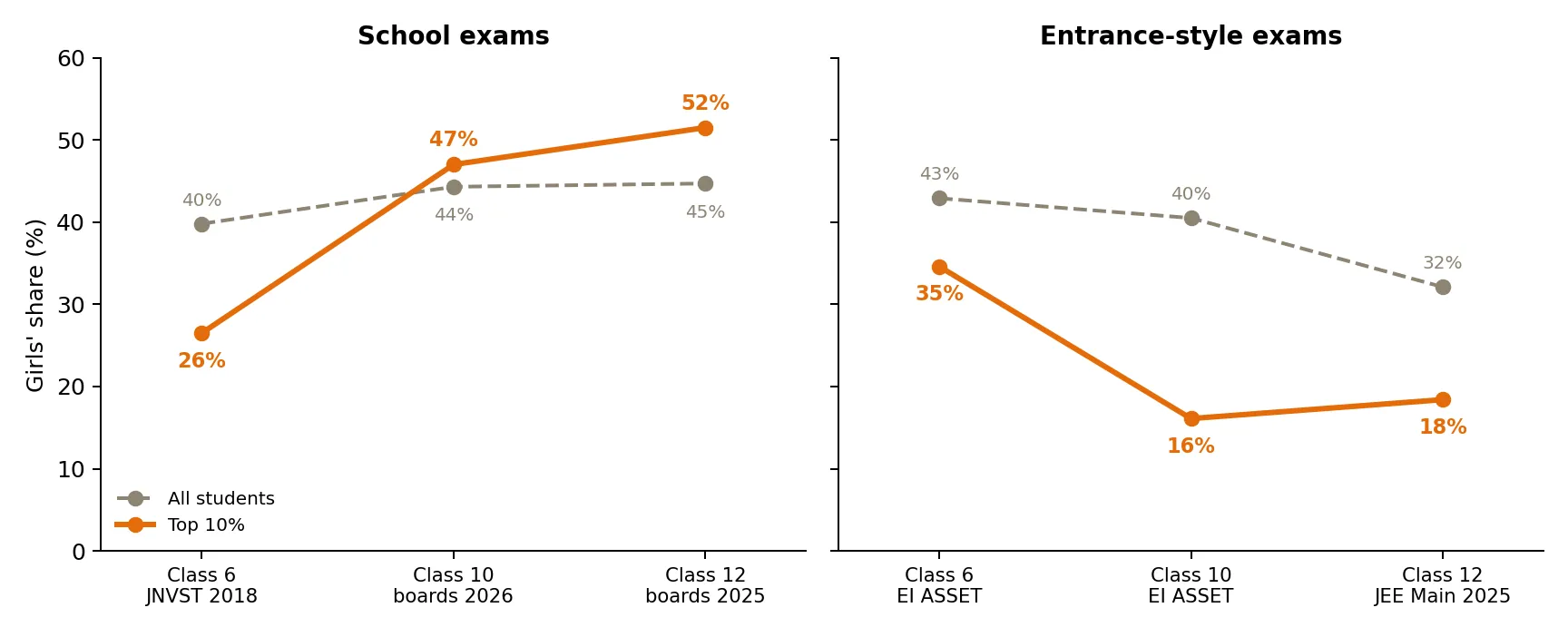
This analysis traces where that gap opens, using a different cohort at each stage rather than one group followed through. It draws on the Navodaya entrance-test records, Class 10 board and NCST results for the whole Navodaya system, JEE results for every Navodaya student, Educational Initiatives’ ASSET maths assessments, and Avanti Fellows’ internal records of the students it teaches. It finds four points where girls fall away.
Fewer girls get in. The Navodayas admit fewer girls than their share of the age group. Girls are 48% of Class 5 children in India but 41% of Navodaya Class 6 (UDISE+ 2024-25). The records cover only admitted children, so whether fewer girls apply or fewer pass cannot be told apart.
Among those who get in, girls are thinner at the top, and thinner the higher the bar. At age 11, girls are under-represented among the strongest maths scorers on the entrance test, and their share falls further at each step up the ladder. By Class 10 the same pattern holds on the competitive, JEE-style tests, even though girls hold their own at the top of their school board exams. Girls are 40% of the children admitted, but 24% of the top 10% on the entrance test’s maths section and 18% of those with its top score; on the Class 10 NCST they are 20% of the top 1%, against 36% in board mathematics and 52% in the board results overall.
Academically strong girls choose engineering less often. Many of the strongest girls move to the medical stream at Class 10. Among the top 10% of Class 10 students on the NCST, 40% of girls choose the engineering stream against 66% of boys. Girls are 24% of the Class 10 top 10%, but only 15% of the top 10% within the engineering stream.
In the two years of exam preparation, girls with the same starting marks score lower. The gap is already visible on Avanti’s first tests in Class 11, and remains after controlling for Class 10 marks, in intensive coaching, in lighter programmes and online. At the same Class 10 marks, girls score about 7 percentile points lower on JEE Main, and in Avanti’s residential centres in 2026, 27% of girls on the engineering track cleared the IIT bar against 43% of boys.
Avanti’s interventions at each step are set out in §7, and the wise interventions in §8. The analysis is descriptive: it shows where girls are lost, not yet what brings them back.
The Lost Girls of Navodaya
Section titled “The Lost Girls of Navodaya”Where high-ability girls leave the path to India’s top engineering colleges.
Avanti Fellows · September 2026
1. Avanti Fellows and the students it teaches
Section titled “1. Avanti Fellows and the students it teaches”Avanti Fellows is a nonprofit that prepares students from low-income families for India’s engineering and medical entrance exams, free of charge. Most of its students are in the Jawahar Navodaya Vidyalayas (JNVs), the government’s network of residential schools for talented rural children, which admit about 46,000 children a year through a national entrance test at the end of Class 5.
Avanti teaches Navodaya students in three ways. Its residential Centres of Excellence (CoEs) take the strongest Class 10 students for two years of intensive coaching. They are selected through the NCST, the Navodaya CoE Selection Test, a JEE-style exam that Navodaya Class 10 students across the country sit to win a CoE place. Its Nodal centres offer a lighter, non-residential version. And an online programme reaches students in every Navodaya.
Across its centres, girls have been close to half of the students, but a smaller share of the results, and a smaller share still at the very top.
| Avanti centres (CoEs and Nodals) | 2024 | 2025 | 2026 |
|---|---|---|---|
| Students | 866 | 1,090 | 1,056 |
| Girls’ share of students | 46.4% | 52.8% | 41.6% |
| Girls’ share of top-tier qualifications | 37.9% | 40.7% | 34.5% |
| Girls’ share of those clearing the IIT bar | 34.1% | 25.6% | 22.5% |
“Top-tier” means clearing JEE Advanced, the NIT-level JEE Main cut, JEE Main, or the government-seat NEET cut. It is a qualification, not an admission. 2026 is provisional. About 1,300 students are recorded twice by a crosswalk error awaiting a data reload; counted once, the centres had 823, 855 and 1,037 students, and the shares move by under a point. The mix of centres also changed: in 2024 and 2025 the JNV CoEs were a few mostly-girls centres, in 2026 a larger, more evenly split network.
The pattern is the same across the whole Navodaya system.
| Navodaya students qualifying on their first attempt | Qualifiers | of whom girls |
|---|---|---|
| JEE Main, 2024–26 | 7,424 | 23% |
| JEE Advanced, 2025 | 300 | 18% |
NTA results for every Navodaya student who sat JEE. First attempt means the exam was taken in the year the student finished Class 12. Students retaking the exam after Class 12, or with no Class 12 year on record, are 53% of all JEE Main qualifiers and are left out, as is 2023, which is incomplete in the source. The source files differ from year to year, so the table pools years rather than comparing them.
The 2024 JEE Advanced file under-records girls who qualified, so JEE Advanced is shown for 2025 only. At that bar Navodaya girls are close to the national share: counting all attempts they were 17.5% of Navodaya JEE Advanced qualifiers in 2025, while across India women were 17% of qualifiers in 2023 and 16.5% in 2024 (Joint Implementation Committee 2023, 2024). The gap is sharpest among the very top scorers: of the first-attempt Navodaya students in the top 1% of JEE Main in 2025, 8% were girls (§4).
The rest of this analysis asks why.
2. Fewer girls get in
Section titled “2. Fewer girls get in”Girls are 48% of Class 5 children in India, but 41% of the children in Navodaya Class 6 (UDISE+ 2024-25). Navodaya admission rules reserve at least a third of seats for girls.
The Navodaya records cover only the children admitted, so two explanations cannot be told apart: fewer girls may apply, or girls who apply may be less likely to pass a test on which, as §3 shows, they are thinner at the top. Early pilots with Piramal and IIMPACT, helping girls apply and prepare, point to simple fixes such as awareness and missing caste and income certificates.
3. At age 11, girls are thinner at the top, and thinner the higher the bar
Section titled “3. At age 11, girls are thinner at the top, and thinner the higher the bar”Among the children the Navodayas admit, girls are 40%. They are close to that share in the middle of the entrance-test distribution, and fall away at the top.
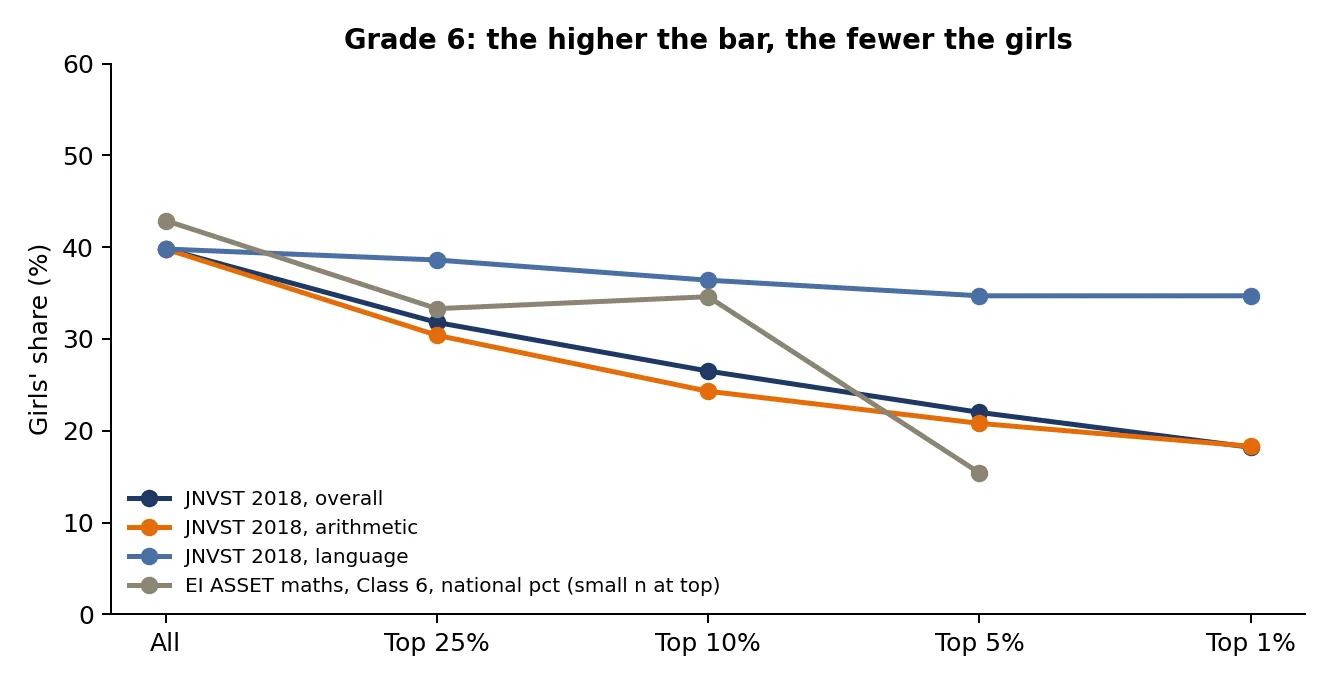
| Grade 6: girls’ share of… | All | Top 25% | Top 10% | Top 5% | Top 1% |
|---|---|---|---|---|---|
| JNVST 2018, overall score | 39.8% | 31.8% | 26.5% | 22.0% | 18.2% |
| JNVST 2018, arithmetic | 39.8% | 30.4% | 24.3% | 20.8% | 18.3% |
| JNVST 2018, language | 39.8% | 38.6% | 36.4% | 34.7% | 34.7% |
| EI ASSET maths, Class 6 | 42.9% | 33.3% | 34.6% | 15.4% (2 of 13) | 0.0% (0 of 2) |
JNVST: all 45,958 children admitted in 2018. EI ASSET: 301 children in five Navodayas in Maharashtra and Gujarat, placed on EI’s national percentile, so a top band means reaching that percentile of EI’s national test-takers; the top cells rest on very few children. JNVST is ranked within its own cohort.
The gap is a maths gap. On language, girls hold close to their share even at the top. On arithmetic and on the overall score, their share falls at every step up, to 18% among those with the top score. These are admitted children only. Because a third of seats are reserved for girls, some girls are admitted at lower marks than boys, which by itself lowers girls’ share of the top among admits, so the ladder may overstate the gap among all applicants of the same ability. The same widening at the top of the maths distribution appears in studies elsewhere. On US standardised tests boys outnumber girls about two to one at the 99th percentile; among US maths competition students the ratio is about four to one at a comparable score and more than ten to one at the very top (Ellison and Swanson 2010). In no country in PISA 2022 was the share of girls reaching the top maths levels larger than the share of boys (OECD 2023). The gap is not fixed: in the US it has narrowed sharply over time, and it differs between groups (Hyde and Mertz 2009). In rural India, girls’ gap in basic maths persists and grows with age, though not in the southern states (Das and Singhal 2023).
4. By Class 10 and 12, girls hold their own in school exams but not in entrance-style tests
Section titled “4. By Class 10 and 12, girls hold their own in school exams but not in entrance-style tests”By Class 10 the picture splits in two.
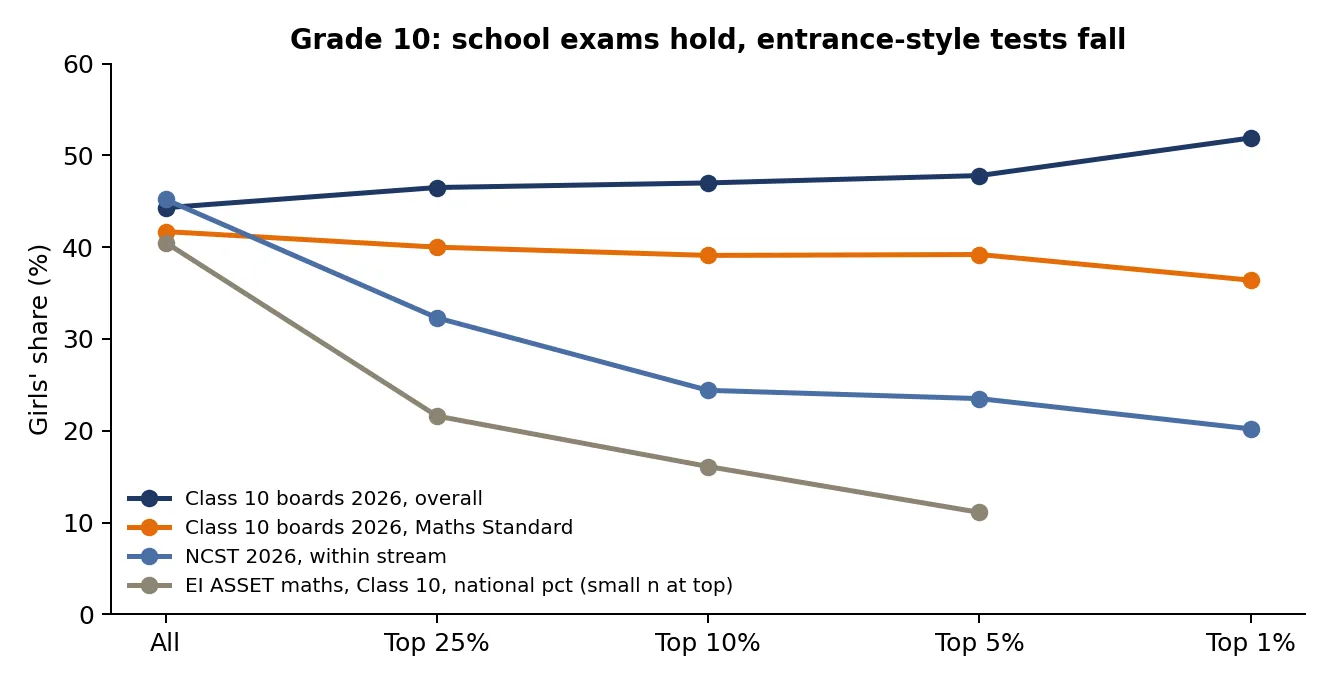
| Grade 10: girls’ share of… | All | Top 25% | Top 10% | Top 5% | Top 1% |
|---|---|---|---|---|---|
| CBSE Class 10 boards 2026, overall | 44.3% | 46.5% | 47.0% | 47.8% | 51.9% |
| CBSE boards 2026, Mathematics Standard | 41.7% | 40.0% | 39.1% | 39.2% | 36.4% |
| EI ASSET maths, Class 10 | 40.5% | 21.6% | 16.1% | 11.1% (1 of 9) | none reached it |
| NCST 2026 | 45.2% | 32.3% | 24.4% | 23.5% | 20.2% |
Boards: every Navodaya Class 10 student in 2026 (45,091); Mathematics Standard ranks its 33,196 takers. EI ASSET: 343 children in five Navodayas, on EI’s national percentile. NCST: 39,419 Class 10 students, each stream ranked on its own paper.
In their school board exams overall, girls are as well represented at the top as in the class as a whole, and the top 1% is majority girls; those results include languages, where girls are strong. In board maths their share slips at the top, to 36% of the top 1% against 42% of takers, and girls are less likely to take Mathematics Standard at all (69% of girls against 77% of boys).
On the two tests that probe conceptual problem-solving rather than the school syllabus, the ladder from Grade 6 returns. On the NCST, which is built like the engineering entrance exam, girls’ share falls from 32% of the top 25% to 20% of the top 1%. EI’s conceptual maths test shows the same fall, on a small sample.
By Class 12 the split is sharper still.
| Grade 12: girls’ share of… | All | Top 25% | Top 10% | Top 5% | Top 1% |
|---|---|---|---|---|---|
| CBSE Class 12 boards 2025, overall | 44.7% | 51.1% | 51.5% | 52.0% | 49.6% |
| CBSE Class 12 boards 2025, Mathematics | 35.0% | 33.8% | 30.8% | 27.9% | 23.5% |
| JEE Main 2025, first attempt | 32.1% | 22.2% | 18.4% | 17.8% | 8.3% |
Boards: every Navodaya Class 12 student in 2025 (33,773); Mathematics ranks its 12,475 takers. JEE Main: 7,226 Navodaya students taking it in the year they finished Class 12, from the one year whose file holds every taker; the top 1% is 72 students.
In the Class 12 board results, girls are over half of the top 10%. In board maths, which fewer girls take, their share falls from 35% of takers to 24% of the top 1%. On JEE Main it falls from 32% of takers to 8% of the top 1%.
So girls are a little behind at the top of board maths and far behind on the kind of test the JEE is: harder and more conceptual, and on the NCST and JEE, timed and with marks taken away for wrong answers (the NCST’s negative marking is described in Avanti, Girls in the CoEs, 2026). Whether that reflects what is taught, how girls respond to that kind of test, or both, cannot be separated with this data.
Research on high-stakes tests points to part of the answer. Women skip more questions when wrong answers are penalised (Baldiga 2014; Pekkarinen 2015), and in China the gender gap is larger in the high-stakes national college entrance exam than in a low-stakes mock exam two months earlier (Cai et al. 2019). But removing the penalty for wrong answers in Chile’s university entrance exam closed only about an eighth of the gap among the top fifth of scorers, even though it removed most of the gap in skipped questions (Coffman and Klinowski 2020), so the penalty for guessing explains little of it.
5. Academically strong girls choose engineering less often
Section titled “5. Academically strong girls choose engineering less often”Among the top 10% of Class 10 students on the NCST, 66% of boys chose the engineering stream, against 40% of girls. The rest of the strongest girls chose medicine.
| NCST 2026, top 10% | Engineering | Medical |
|---|---|---|
| Boys | 1,996 | 1,035 |
| Girls | 368 | 547 |
| Girls, at boys’ rate | 603 | 312 |
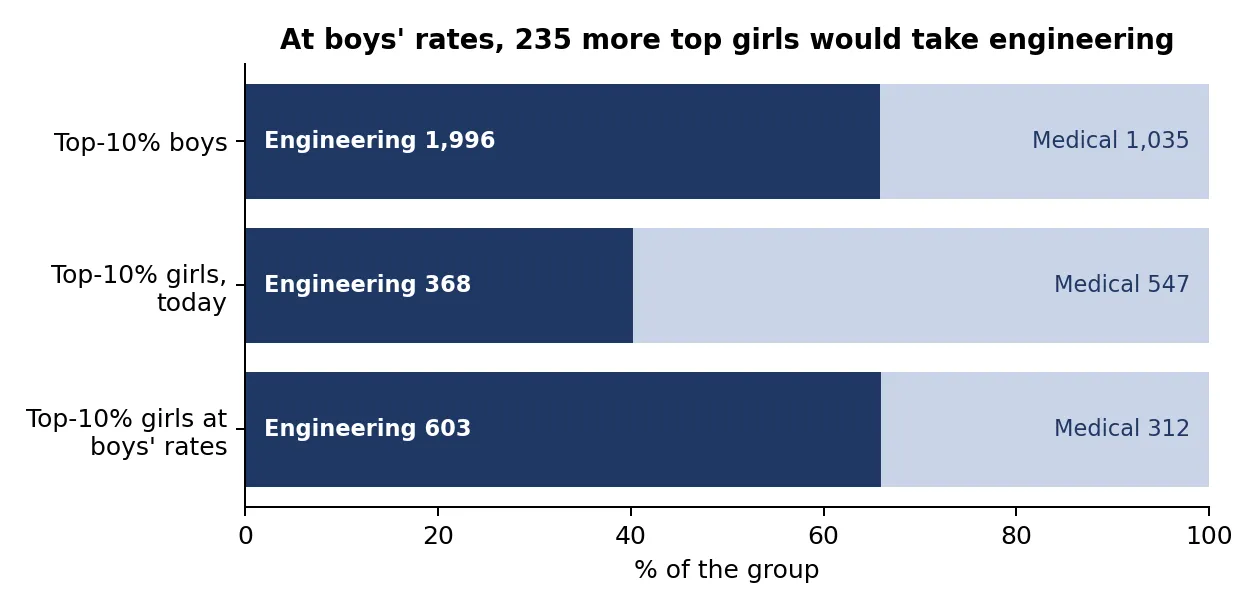
Here the top 10% ranks all NCST takers together so that streams can be compared; the two papers are not equated, so the split depends partly on their relative difficulty, though boys’ 90th-percentile scores on the two papers are almost identical.
If girls chose as boys do, about 235 more high-ability girls in 2026 would have been on the engineering path. The two paths lead to very different odds. A government medical seat is among the hardest in the country to win, and few Navodaya families can pay for a private one, while an NIT seat is within reach of many more strong engineering students. Many girls who choose medicine want to be doctors, so the 235 is an upper bound on how many choices might change.
The pattern is not unique to India. Pooling 15-year-olds in 61 countries, the gender gap in intending to pursue maths-related studies or careers grows steadily with maths performance and is largest among the strongest students (Breda, Jouini and Napp 2023).
6. In the preparation years, girls score below boys with the same starting marks
Section titled “6. In the preparation years, girls score below boys with the same starting marks”Girls who win a place in Avanti’s centres arrive with Class 10 marks close to boys’. Two years later, they do markedly worse on JEE.
| 2026, engineering track, sat JEE Main | CoE girls | CoE boys | Nodal girls | Nodal boys |
|---|---|---|---|---|
| Students | 132 | 280 | 126 | 224 |
| Class 10 maths (mean %) | 89.4 | 92.6 | 82.4 | 84.1 |
| Qualified JEE Main (%) | 79.5 | 91.4 | 11.9 | 28.1 |
| Cleared JEE Advanced (%) | 26.5 | 42.5 | 0.8 | 2.2 |
Avanti student record, 28 September 2026. CoE includes JNV and State CoEs.
The gap remains after controlling for where girls started. On Avanti’s own tests in the first months of Class 11, girls score about 3.5 to 5.5 points below boys who had the same NCST score and the same Class 10 marks.1 By JEE, girls score about 7 percentile points below boys with the same Class 10 marks, and pooled over three years the gap is as large in the intensive CoEs as in the lighter Nodals, though at the CoEs it narrowed each year.2 Online, girls have about half the odds of qualifying of boys with the same marks, and more practice does not narrow the gap.3
| Girls minus boys at the same centre, first Avanti tests (points) | Physics | Chemistry | Maths | Overall |
|---|---|---|---|---|
| No adjustment | −4.9 | −3.9 | −5.3 | −4.2 |
| Same NCST score | −3.6 to −4.4 | −3.0 to −3.5 | −4.2 to −5.3 | −2.8 |
| Same NCST score and Class 10 marks | −4.5 to −4.9 | −3.8 to −4.2 | −4.9 to −5.5 | −3.5 |
Percentage points of each test’s maximum marks, first three months of Class 11 (June–September 2026), 727 students at the CoEs (340 girls). Ranges are across ways of controlling for the score; all are statistically clear. Source: Avanti, Girls in the CoEs, 2026.
Followed through the two-year course, the gap widened for the cohort that sat JEE in 2026: from 3.0 points behind in the first half of Class 11 to 4.8 behind by the first half of Class 12, on the same six centres and against boys with the same Class 10 marks. The cohort that sits JEE in 2027 arrived further behind, at 6.6 points, and has closed to 4.3. By Class 12 both sit in about the same place.
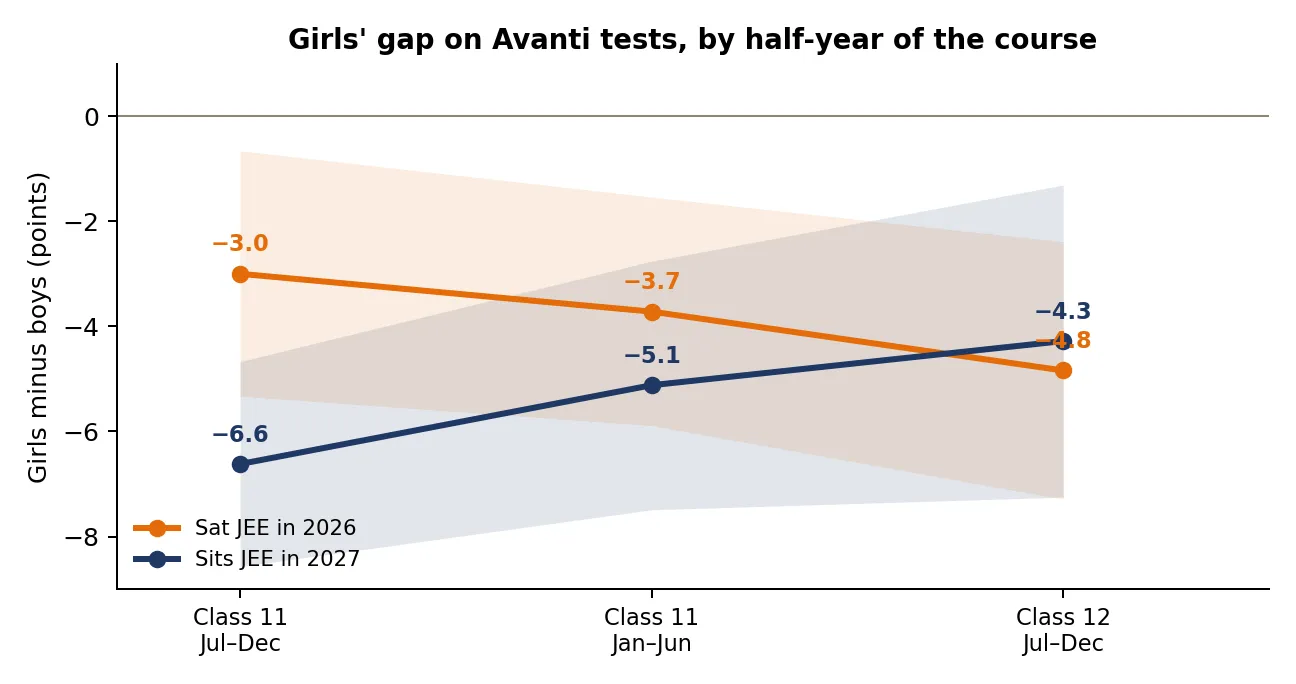
Percentage points of each paper, overall score, with 95% ranges. The six centres with girls and boys tested at every stage in both cohorts: Adilabad, Barwani, Chandigarh, Cuttack, Hassan, Kurnool. NCST scores are available only for the cohort that entered in 2026, so these lines control for Class 10 marks, not NCST. Source: Avanti, Girls in the CoEs, 2026.
The cost is at the top. In the CoEs, 27% of girls cleared the IIT bar against 43% of boys, and most of the difference is girls who reached no top-tier qualification at all.4
In the JNV CoEs, the share of girls reaching a top-tier qualification held near 50% in 2024 and 2025 and rose to 77% in 2026, while boys stayed between 90% and 100%. In the Nodals, girls’ results did not improve relative to boys’.
| Reached a top-tier cut (students) | 2024 | 2025 | 2026 |
|---|---|---|---|
| JNV CoE, girls | 55.6% (99) | 50.7% (136) | 77.2% (202) |
| JNV CoE, boys | 100% (26) | 92.3% (26) | 90.2% (287) |
| Nodal, girls | 20.2% (292) | 13.7% (380) | 8.4% (237) |
| Nodal, boys | 34.4% (389) | 31.3% (409) | 22.7% (330) |
The rise cannot be read as improvement on its own. In 2026 girls fell from over 80% of JNV CoE students to 41%, as the network grew beyond a few mostly-girls centres, so the girls in it were a more selected group; the boys’ rates in 2024 and 2025 rest on 26 boys each. Several things also changed in the centres that year (§7).
7. Avanti’s interventions across the steps
Section titled “7. Avanti’s interventions across the steps”Getting more girls in: outreach before the entrance test. Pilots with Piramal in Jharkhand and IIMPACT in Rajasthan help girls hear about the Navodaya test, apply and prepare. Early work finds simple barriers, such as awareness and missing caste and income certificates.
Finding high-potential girls early: a talent-identification coalition. Sattva, Central Square Foundation, Educational Initiatives, GenWise and Avanti are building a national effort to identify and nurture high-potential learners, modelled on the Johns Hopkins Center for Talented Youth. Its first phase starts in October 2026 with research and stakeholder work. Alongside it, Avanti plans a pilot in 10 to 20 Navodayas that picks out strong Class 7 students from their Class 6 maths marks and teacher nominations and gives them an advanced problem-solving maths course, with results analysed by gender.
Changing the stream choice: gender-intentional counselling in Class 10. With Breakthrough, which works on gender norms with young people, Avanti is piloting career and parent sessions for Class 10 girls in two to four Navodayas in Karnataka, Telangana and Andhra Pradesh. Researchers from the University of Wisconsin, working through J-PAL, have ethics approval, and a randomised trial is planned from 2027.
Closing the preparation-year gap: wise interventions. A randomised study of two short exercises with Greg Walton’s lab at Stanford, in its second year. Its theory and design are in §8.
Inside the centres. From the 2026-27 intake, girls’ and boys’ CoE seats are filled from separate merit lists so that each centre moves towards half girls. More female teachers have been appointed, girls have space to study together, hostel study hours have been extended, and girls take part in sessions on belonging and exam anxiety.
8. The wise interventions: theory and design
Section titled “8. The wise interventions: theory and design”Theory of change
Section titled “Theory of change”Girls who reach a Centre of Excellence meet a harder, faster and more competitive environment than any they have known, and §6 shows they fall behind boys with the same marks from the first tests. Avanti’s staff describe the problem as belonging and test anxiety, and its own survey of students in the physical centres finds girls report more stress than boys, with the highest levels among Class 12 girls.5
The wise interventions target how students interpret that difficulty, not what they know. A girl who reads an early bad test as proof that she does not belong in engineering may stop asking for help, drop maths or disengage; the same result read as a normal part of a hard transition does less harm. The exercises are short, one sitting each, and aim to change that reading:
- Class 11, transitional stories. Students read stories from senior students about struggling in their first months and getting through it, to normalise early setbacks.
- Class 12, values affirmation. Students write about their core values and personal strengths, to buffer the pressure of the final exam year.
The intended chain runs from a stronger sense of belonging and a healthier view of stress, to more persistence and help-seeking, to better test performance, to more girls choosing maths and qualifying in JEE Main, which the study treats as its primary end point.6 The exercises were developed with Greg Walton’s lab at Stanford, which designed this family of interventions in the US, and adapted to what Avanti’s girls said about their own experience.
The evidence behind the exercises
Section titled “The evidence behind the exercises”Both exercises come from a body of US trials. A short belonging exercise, in which first-year students read that worry about fitting in is common and passes, halved the Black-white grade gap at a selective college over three years (Walton and Cohen, 2011). The closest precedent for Avanti’s Class 11 exercise is in engineering: the same exercise, and a second one, closed the gender gap in grades over the first year at a Canadian engineering school, but only in majors where fewer than a fifth of students were women (Walton et al., 2015). Values affirmation, the basis of the Class 12 exercise, cut the racial gap in grades by 40% among seventh-graders (Cohen et al., 2006) and closed about 61% of the gender gap on exams in university physics (Miyake et al., 2010).
The same literature says where the exercises fail, and this is what the Avanti trial tests:
- They need fertile ground. The exercises change how a student reads a setback, not what she knows, so they help only where the school offers real chances to learn and to belong (Yeager and Walton, 2011; Walton and Yeager, 2020). In a trial at 22 US colleges and universities the belonging exercise worked only where students’ groups had those chances (Walton et al., 2023).
- Effects shrink at scale. A large replication of values affirmation in one US school district found no effect (Hanselman et al., 2017), and a meta-analysis of 58 studies found a small average effect for students facing a stereotype and none for others, largest where the gap is big and resources are plentiful (Wu et al., 2021).
- They have not been tested in India. Every trial above ran in the US or Canada, in English, in universities or middle schools. Avanti’s trial runs in government residential schools, in regional languages, ahead of a single high-stakes exam.
Design
Section titled “Design”| Year 1 (2025-26) | Class 11 | Class 12 |
|---|---|---|
| Exercise | Transitional stories | Values affirmation |
| Schools | 29 (CoEs and Nodals) | 12 (mostly CoEs) |
| Students | 1,102 | 481 |
| When | November 2025 | December 2025 |
- Randomisation. Students were randomly assigned within each school to the exercise or to a structurally similar control activity on study skills.
- Delivery. A 45-minute digital exercise run by Avanti teachers in school, with scripts and checklists, in English or the regional language.
- Consent. The ethics board required written consent from every parent rather than an opt-out; the board approved an amendment for the second year in July 2026.
- Outcomes. Surveys of belonging, stress mindset and self-efficacy before and after, and students’ scores on Avanti’s all-India tests, with JEE Main as the end point.
- Power. The original design needed about 390 engineering-track girls in each arm; the centres had about 200 in total, so year 1 was analysed across all students rather than for engineering girls alone.
Year 2
Section titled “Year 2”The second year, 2026-27, began in August and September 2026. It times the exercises between Avanti’s all-India tests, uses short-term enumerators for surveys and consent calls, and adds EMRS Centres of Excellence. It is designed to give a cleaner answer on whether the exercises change girls’ results. Results will be reported by the research team.
9. What this analysis does not show
Section titled “9. What this analysis does not show”- How many girls never apply. The Navodaya records cover only the children admitted.
- Why girls are thinner at the top. The analysis assumes girls and boys have the same underlying ability, so that a smaller share at the top reflects opportunity. It does not test this.
- Why the gap appears on entrance-style tests and not in board exams. Teaching, test format and how girls respond to high-stakes tests could each play a part.
- What caused the CoE improvement. It is consistent with girls responding to the changes, not proof of it.
References
Section titled “References”A companion review of the Indian and international evidence on why the maths gap widens in adolescence is Why girls fall behind in maths in adolescence.
Sources were downloaded and read before being cited; each was opened on 29 September 2026. The
[download] after a reference is the copy that was read; it opens only for someone signed in with an avantifellows.org Google account.
Checksums are in SOURCES.md.
- Baldiga, K. (2014). Gender differences in willingness to guess. Management Science 60(2), 434–448. download
- Breda, T., Jouini, E. and Napp, C. (2023). Gender differences in the intention to study math increase with math performance. Nature Communications 14, 3664. download
- Cai, X., Lu, Y., Pan, J. and Zhong, S. (2019). Gender gap under pressure: Evidence from China’s National College Entrance Examination. Review of Economics and Statistics 101(2), 249–263. download
- Coffman, K. B. and Klinowski, D. (2020). The impact of penalties for wrong answers on the gender gap in test scores. PNAS 117(16), 8794–8803. download
- Cohen, G.L., Garcia, J., Apfel, N. and Master, A. (2006). Reducing the racial achievement gap: a social-psychological intervention. Science 313, 1307–1310. download
- Das, U. and Singhal, K. (2023). Solving it correctly: Prevalence and persistence of gender gap in basic mathematics in rural India. International Journal of Educational Development 96, 102703. download
- Ellison, G. and Swanson, A. (2010). The gender gap in secondary school mathematics at high achievement levels: Evidence from the American Mathematics Competitions. Journal of Economic Perspectives 24(2), 109–128. download
- Hanselman, P., Rozek, C.S., Grigg, J. and Borman, G.D. (2017). New evidence on self-affirmation effects and theorized sources of heterogeneity from large-scale replications. Journal of Educational Psychology 109(3), 405–424. download
- Hyde, J. S. and Mertz, J. E. (2009). Gender, culture, and mathematics performance. PNAS 106(22), 8801–8807. download
- Joint Implementation Committee (2023). JEE (Advanced) 2023 Report. IIT Guwahati. jeeadv.ac.in/reports/2023.pdf download
- Joint Implementation Committee (2024). JEE (Advanced) 2024 Report. IIT Madras. jeeadv.ac.in/reports/2024.pdf download
- Miyake, A., Kost-Smith, L.E., Finkelstein, N.D., Pollock, S.J., Cohen, G.L. and Ito, T.A. (2010). Reducing the gender achievement gap in college science: a classroom study of values affirmation. Science 330, 1234–1237. download
- OECD (2023). PISA 2022 Results (Volume I): The State of Learning and Equity in Education. OECD Publishing, Paris. download
- Pekkarinen, T. (2015). Gender differences in behaviour under competitive pressure: Evidence on omission patterns in university entrance examinations. Journal of Economic Behavior and Organization 115, 94–110. download
- Walton, G.M. and Cohen, G.L. (2011). A brief social-belonging intervention improves academic and health outcomes of minority students. Science 331, 1447–1451. download
- Walton, G.M. and Yeager, D.S. (2020). Seed and soil: psychological affordances in contexts help to explain where wise interventions succeed or fail. Current Directions in Psychological Science 29(3), 219–226. download
- Walton, G.M., Logel, C., Peach, J.M., Spencer, S.J. and Zanna, M.P. (2015). Two brief interventions to mitigate a “chilly climate” transform women’s experience, relationships, and achievement in engineering. Journal of Educational Psychology 107(2), 468–485. download
- Walton, G.M., Murphy, M.C., Logel, C., Yeager, D.S., Goyer, J.P., Brady, S.T. et al. (2023). Where and with whom does a brief social-belonging intervention promote progress in college? Science 380, 499–505. download
- Wu, Z., Spreckelsen, T.F. and Cohen, G.L. (2021). A meta-analysis of the effect of values affirmation on academic achievement. Journal of Social Issues 77(3), 702–750. download
- Yeager, D.S. and Walton, G.M. (2011). Social-psychological interventions in education: they’re not magic. Review of Educational Research 81(2), 267–301. download
Appendix A. Data and samples
Section titled “Appendix A. Data and samples”| Source | What it is | n | Used in |
|---|---|---|---|
| UDISE+ 2024-25 | Enrolment by class, gender and school type | all schools | §2 |
jnv_fact_selection_test_results |
JNVST 2018, every admitted child | 45,958 | §3 |
jnv_fact_ei_asset_test_results |
EI ASSET maths, five Navodayas | 301 (Class 6), 343 (Class 10) | §§3–4 |
jnv_fact_board_results_10th |
CBSE Class 10, every Navodaya student, 2026 | 45,091 | §4 |
nvs_fact_ncst_results |
NCST 2026, Class 10 | 39,419 | §§4–5 |
jnv_fact_jee_results |
JEE results for every Navodaya student | 7,424 first-attempt JEE Main qualifiers, 2024–26 | §1 |
| Avanti golden student record | Avanti students by cohort and qualification | 866–1,090 at the centres a year | §§1, 6 |
| CoE impact regression; Practice Predicts Qualification; Girls in the CoEs | Avanti’s internal studies | see footnotes | §6 |
| Students behind §6 | 2024 | 2025 | 2026 |
|---|---|---|---|
| JNV CoE girls / boys | 99 / 26 | 136 / 26 | 202 / 287 |
| Nodal girls / boys | 292 / 389 | 380 / 409 | 237 / 330 |
Definitions. Each test is ranked within its own group; a top band is an exact share of the group, with a tied boundary split pro rata. Top-tier means clearing JEE Advanced, the NIT-level JEE Main cut, JEE Main, or the government-seat NEET cut.
Re-running. jnv_qualifiers.py (§1), representation.py (§§2–4), reproduce_funnel.py (§5),
gap4_facts.py (§§1, 6) and make_figures.py rebuild every number and figure; check_paper.py fails
if the text drifts from them. Aggregates only.
Footnotes
Section titled “Footnotes”-
Avanti, Girls in the CoEs, 2026: 2028 cohort, 727 students, girls against boys with the same NCST score and Class 10 marks at the same centre. Overall −3.5 points; by subject −4.5 to −5.5. ↩
-
Avanti’s CoE impact regression, JEE Main percentile on a female indicator plus Class 10 maths and science, pooled 2024–26: CoE −7.2 (SE 0.9, n = 1,231), Nodal −7.1 (1.2, n = 1,023). By year, CoE −13.4 (2024), −8.9 (2025), −4.8 (2026). Standard errors are not clustered by centre, so the intervals are not valid as stated, and the model does not control for category, which differs by gender at the CoEs. The regression was run on the impact study’s own sample of CoE JEE takers linked to Class 10 marks, defined differently from the student record in §1 and larger in some years; the two have not been reconciled. ↩
-
Avanti, Practice Predicts Qualification, 2026, §8: 2026 online engineering stream; female odds ratio 0.51 [0.41, 0.63] net of Class 10 marks and category. ↩
-
CoE 2026 engineering track: cleared JEE Advanced 26.5% of girls vs 42.5% of boys; stopped at the NIT-level cut 30.3% vs 27.1%; stopped at JEE Main (top state engineering) 22.7% vs 21.8%; no top-tier qualification 20.5% vs 8.6%. ↩
-
Perceived Stress Scale (PSS-4), Avanti physical centres, October 2025: 224 Class 11 girls and 197 boys, 117 Class 12 girls and 96 boys. ↩
-
Avanti, Wise interventions: note (June 2026) and the Agency Fund proposal (June 2026). Primary outcomes: opting into mathematics (then about 30% of girls), scaled scores on STEM tests, and university applications; secondary: self-efficacy, belonging and identity. ↩